
How to Get a Frontend Developer Job in Dubai in 2026
03 June 2026
246 views
This guide is up to date as of August 2026

Written by
Marcus Hale,
IT Talent Acquisition Specialist

Reviewed by
Omar Al Mansoori,
Tech Recruitment Consultant, United Arab Emirates
Dubai doesn't compete with Silicon Valley on prestige, or with Berlin on work-life balance. It competes on something else entirely: momentum. The city added over 40,000 tech sector jobs between 2022 and 2025, signed strategic partnerships with AWS, Microsoft, and Google to establish major cloud infrastructure in the region.
The developers who build genuinely strong careers in Dubai - the ones who stay, grow, get promoted, or leverage Dubai as a launchpad into broader MENA markets - do something different. They understand how the job market here actually works: which industries are genuinely hiring, what a UAE-based hiring process looks like from first message to signed offer, how visa mechanics shape your leverage as a candidate, and what the day-to-day of being a frontend developer in this city actually involves.
What Frontend Developers Actually Earn in Dubai in 2026
Let's skip the usual salary range dump. You've seen those tables - "Junior: X-X-X-Y, Senior: A-A-A-B" - they're everywhere, and they're almost useless without context. What actually matters is the full compensation picture: what the market pays at each level, what drives those numbers up or down, and whether what's left after you pay rent and eat is genuinely more than you'd keep somewhere else.
A few things shape Dubai frontend salaries. First, stack specificity matters more here than in most markets. A React + TypeScript developer with Next.js experience is not in the same hiring pool as someone listing "HTML, CSS, JavaScript" on their CV. The gap between those two profiles at mid-level can be AED 4,000-6,000 per month - not a rounding error. Second, company type creates massive variance. A frontend developer at a local retail conglomerate and a frontend developer at a Series B fintech in DIFC might have identical titles and experience levels but completely different compensation structures. Third, the "all-in" package trap is real. Many UAE job postings quote a total package figure that bundles housing allowance, transport allowance, and annual flight tickets into the headline number. Always decompose the offer before comparing it to anything.
| Level | Typical monthly salary in Dubai (AED) | Notes |
| Junior (0-2 years) | 4,000-8,000 | Entry-level roles often start near the lower end, especially in smaller companies. |
| Mid-level (2-5 years) | 9,000-18,000 | This is the most common range for developers with solid production experience. |
| Senior (5+ years) | 18,000-30,000+ | Senior salaries vary a lot based on company size, product complexity, and stack. |
| Lead / Architect | 28,000-45,000+ | Higher-end roles in strong teams or international companies can go above this range. |
Used sites:
- Indeed Dubai front end developer salary: https://ae.indeed.com/career/front-end-developer/salaries/Dubai
- Glassdoor Dubai front end developer salary: https://www.glassdoor.co.in/Salaries/dubai-front-end-developer-salary-SRCH_IL.0,5_IC2204498_KO6,25.htm
- Naukrigulf front-end developer salary in UAE: https://www.naukrigulf.com/salaries/front-end-developer-salary-in-uae
- JobX Dubai salary guide 2026: https://jobxdubai.com/salaries-2026/front-end-developer-digital-uae-2026
- Reddit discussion for lower-end market examples: https://www.reddit.com/r/dubai/comments/jnpqvr/what_is_the_salary_range_for_junior_frontend/
The most realistic working range for many frontend roles in Dubai is around AED 7,000-15,000/month for junior to mid-level profiles, while senior and lead positions can go much higher.
One more thing worth saying plainly: Dubai salaries have not kept pace with Dubai's cost of living over the past three years. The post-pandemic expat surge drove rents up sharply. A compensation package that felt generous in 2021 looks different in 2026 against a rental market that has repriced entire neighborhoods.
What Actually Stays in Your Pocket: A Real Breakdown
Most salary comparisons stop at the gross figure and wave vaguely at "no income tax." That's accurate but incomplete. Here's what the monthly math actually looks like for a mid-level frontend developer earning AED 15,000/month - a realistic, slightly-above-median figure for someone with 3-4 years of experience and a solid React/TypeScript background, working at a product company in Dubai.
| Item | Amount (AED) | Running Balance |
| Monthly salary (gross) | +15,000 | AED 15,000 |
| Income tax | 0 | AED 15,000 |
| 1BR apartment, decent area (JVC, Al Barsha, Jumeirah Village) | −6,500 | AED 8,500 |
| Groceries + dining (mix of cooking and eating out) | −1,600 | AED 6,900 |
| Transport (Metro + Uber, no car) | −550 | AED 6,350 |
| Health insurance top-up (employer covers basic) | −300 | AED 6,050 |
| Utilities + internet + phone | −450 | AED 5,600 |
| Personal spending, subscriptions, misc | −700 | AED 4,900 |
| Monthly savings potential | ≈ AED 4,900 (~$1,335) |
A few notes on these numbers. The rent figure assumes paying monthly via a property management company - if you pay a full year upfront (standard practice in Dubai), you can negotiate this down to AED 5,500-6,000 for the same apartment, which improves the savings number meaningfully. The transport line assumes no car; owning and insuring a vehicle adds AED 1,500-2,500/month depending on the model and parking situation. The health insurance line assumes the employer provides mandatory basic coverage and you're topping up for dental and better hospital access - skipping the top-up saves AED 300 but leaves gaps.
At AED 15,000/month, you're saving roughly 32% of your gross income after all living costs. That's a reasonable baseline - not spectacular, but genuinely solid for an international city of this size.
Dubai vs. Berlin vs. Lisbon: The Number That Actually Matters
Gross salary comparisons between cities are almost meaningless. A developer earning €65,000 in Berlin (Germany) sounds well-paid until you run the actual deductions. One earning AED 15,000 in Dubai sounds moderate until you remember the tax line is zero. And someone earning €42,000 in Lisbon (Portugal) might be struggling or comfortable depending entirely on their neighborhood and lifestyle.
The only number worth comparing is monthly disposable income after tax, social contributions, and realistic living costs - the money you can save, invest, or send home. Here's that comparison for a mid-level frontend developer with 3-4 years of experience in each city.
| Dubai | Berlin | Lisbon | |
| Gross monthly salary | AED 15,000 (~$4,085) | €5,200 (~$5,640) | €3,200 (~$3,470) |
| Income tax | AED 0 | ~€1,560 (30%) | ~€768 (24%) |
| Social contributions | AED 0 | ~€1,040 (20%) | ~€416 (13%) |
| Take-home pay | AED 15,000 | ~€2,600 | ~€2,016 |
| Rent (1BR, decent area) | −AED 6,500 (~$1,770) | −€1,350 (~$1,465) | −€1,050 (~$1,139) |
| Food + transport + utilities | −AED 2,600 (~$708) | −€750 (~$814) | −€580 (~$629) |
| Monthly savings | ≈ AED 4,900 (~$1,335) | ≈ €500 (~$542) | ≈ €386 (~$419) |
| Savings as % of gross | ~32% | ~9.6% | ~12% |
The gap is larger than most people expect - and it compounds. A Dubai developer at this level saves roughly 2.5× more per month than the equivalent Berlin profile, and over 3× more than Lisbon, despite Lisbon's lower cost of living. Over two years, that's a difference of approximately $19,000-$22,000 in accumulated savings - before any investment returns.
Two important caveats. Berlin's €5,200 gross for a mid-level frontend developer is realistic but assumes a product company or well-funded startup - agency rates in Germany are lower. Lisbon's €3,200 reflects the current market honestly; remote-first companies paying "local rates" often pay less. And Dubai's AED 15,000 figure applies to someone in a product role, not an agency - agency mid-level rates in Dubai cluster around AED 10,000-12,000, which changes the math noticeably.
Is It Worth Moving to Dubai as a Frontend Developer? An Honest Answer
The short answer: it depends entirely on your situation. Dubai is one of the most genuinely compelling tech destinations in the world for the right developer profile - and a frustrating, expensive miscalculation for the wrong one. The problem is that most content about Dubai is written by people who either love it unconditionally or never went. What follows is neither.
There's a version of the Dubai move that works extremely well: you arrive with 3+ years of experience, a in-demand stack, clear financial goals, and a realistic picture of what the city is and isn't. You spend 2-3 years building savings, expanding your professional network into a genuinely international market, and leaving with significantly more capital than you would have accumulated elsewhere. That version is real and repeatable.
There's another version: you arrive underprepared, underestimate the cost of living, overestimate entry-level demand, and find yourself in a visa-dependent employment situation with less financial cushion than you had at home. That version is also real, and it doesn't get written about much because people don't like admitting it happened.
The difference between those two outcomes usually comes down to timing, seniority, and clarity of intent - not luck.
Dubai Makes Sense If...
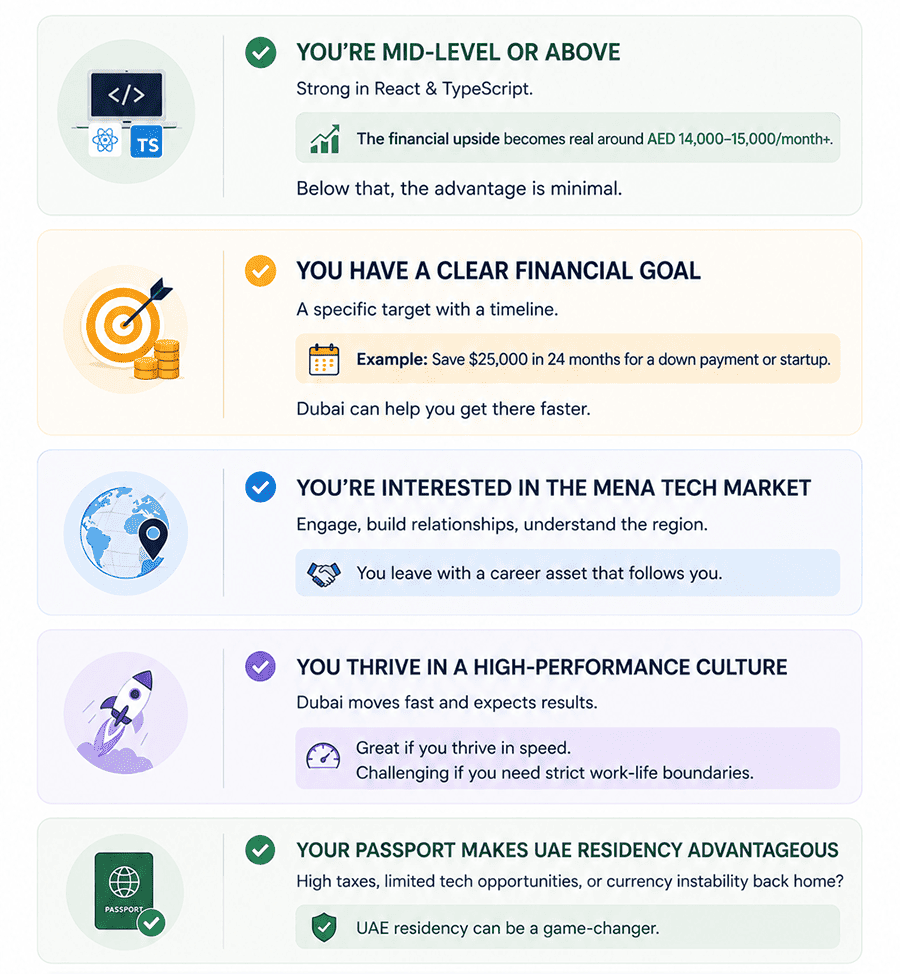
- You're at mid-level or above, with React and TypeScript in your daily workflow. The financial argument only becomes compelling from around AED 14,000-15,000/month upward. Below that, the savings advantage over a mid-cost European city shrinks to the point where lifestyle trade-offs stop being worth it for most people.
- You have a specific financial goal with a defined timeline. "Earn more" is not a plan. "Save $25,000 in 24 months to fund a down payment or startup runway" is a plan - and Dubai can deliver it at mid-to-senior level if you're disciplined about spending.
- You're genuinely interested in the MENA tech market, not just using Dubai as a tax-efficient backdrop. Developers who engage with the regional ecosystem - who understand what's happening in Saudi Arabia's Vision 2030 tech buildout, who build relationships across the Gulf - leave Dubai with a career asset that follows them. Those who treat it as a financial layover leave with savings and not much else.
- You're comfortable with a high-performance, results-oriented work culture. Dubai's tech environment, particularly in fintech, proptech, and e-commerce, moves fast and expects visible output. If you thrive in that environment, the city rewards it. If you need strong work-life boundary culture to do your best work, you'll find Dubai's defaults misaligned.
- You hold a passport that makes UAE residency genuinely advantageous - not just tax-neutral. For developers from countries with high income tax, limited tech market depth, or currency instability, the UAE residency proposition is particularly strong.
Dubai Probably Isn't the Right Move If...
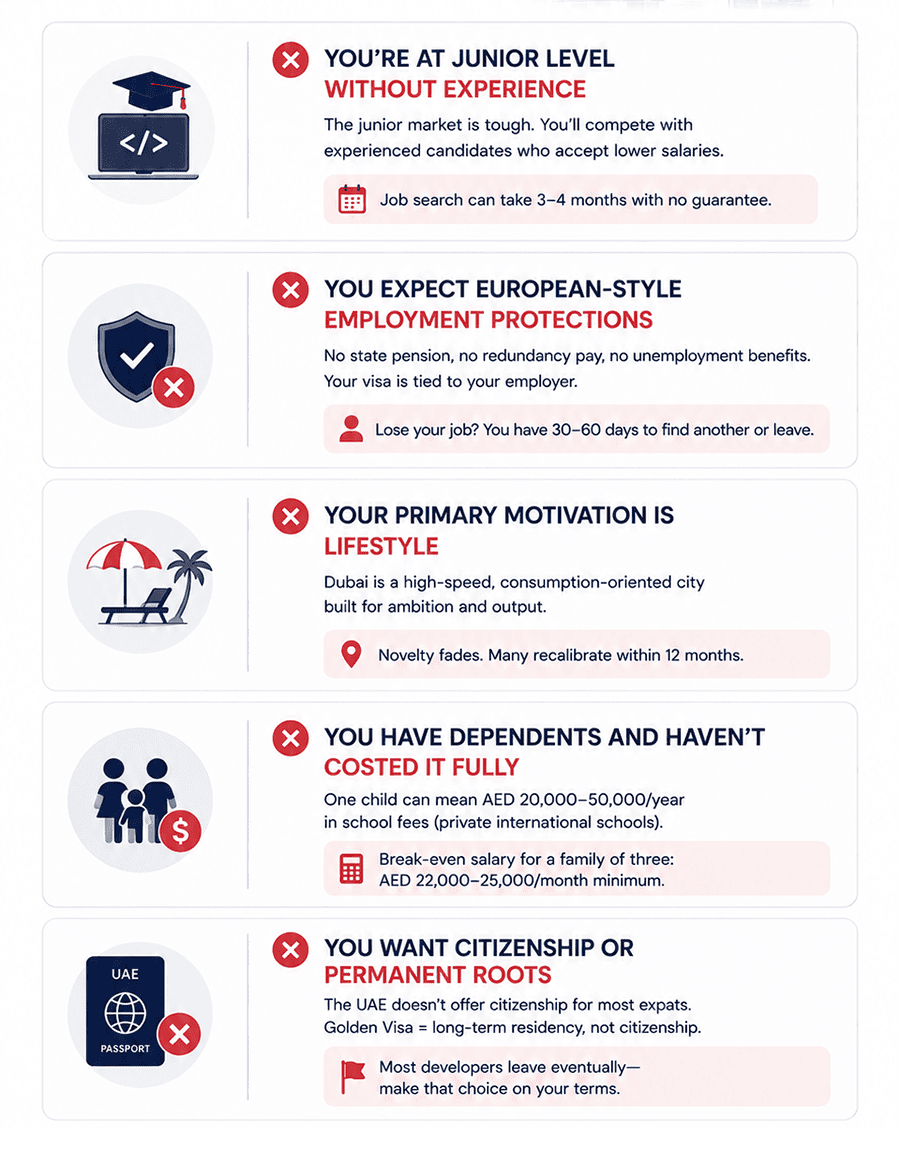
- You're at junior level without at least 18 months of commercial experience. The junior frontend market in Dubai is genuinely difficult. You're competing directly with highly qualified candidates from India, Pakistan, and Egypt who often have 2+ years of experience and accept lower starting salaries. Without a strong portfolio, a distinctive stack, or an unusual niche, the job search at this level can stretch to 3-4 months with no guarantee of outcome.
- You're expecting European-style employment protections. There's no state pension system for expats, no standard redundancy payment structure equivalent to what exists in Germany or France, and no unemployment benefit if things go wrong. Your employment visa is tied to your employer - lose the job and you have a 30-60 day grace period to find another or leave the country. That's not a dealbreaker, but it needs to be priced into your decision honestly.
- Your primary motivation is lifestyle rather than financial or professional gain. Dubai is a remarkable city in many ways, but it's not a culturally rich European capital, a walkable creative hub, or a place with deep historical texture. It's a high-speed, consumption-oriented metropolis built for ambition and output. Developers who move for the weather, the novelty, or a vague sense of adventure tend to recalibrate within 12 months.
- You have dependents and haven't fully costed what that means here. A spouse's dependent visa is manageable. Add one school-age child to the picture and you're looking at AED 20,000-50,000 per year in school fees alone - private international schools are the only realistic option for most expat families. The savings math changes substantially, and the break-even salary point moves up to AED 22,000-25,000/month minimum for a family of three to feel genuinely comfortable.
- You're hoping to eventually become a UAE citizen or build permanent roots. The UAE doesn't offer a citizenship pathway for the vast majority of expats. The Golden Visa provides long-term residency security for senior earners, but it's residency, not citizenship. Most developers who come to Dubai leave eventually - the question is whether you're making that transition on your terms or the market's.
The honest framing is this: Dubai rewards developers who arrive with a plan, the right experience level, and clear-eyed expectations. It's not a shortcut and it's not a lifestyle upgrade for everyone. But for a specific profile - mid-to-senior, financially motivated, internationally oriented, and ready to engage seriously with a fast-moving market - it's one of the strongest career moves available in 2026.
UAE Visa Options for Frontend Developers
Before you apply to a single job in Dubai, understand one thing: the visa system here is not a formality you sort out after accepting an offer. It shapes your negotiating position, your job security, your ability to freelance on the side, and your options if things go wrong. Most developers research this too late - after they've already committed to a move.
Employment Visa - The Standard Path
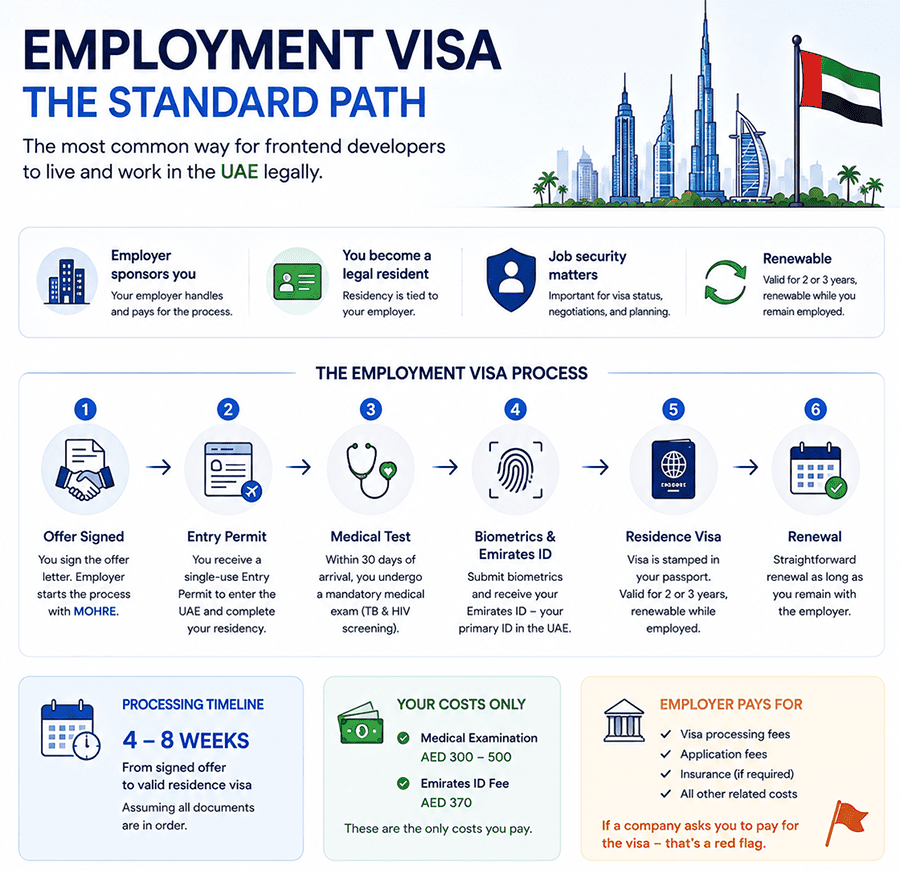
The Employment Visa is how the overwhelming majority of frontend developers enter and work in the UAE legally. The model is straightforward: your employer sponsors your residency, handles the bureaucratic process, and bears the cost. You become a legal resident of the UAE tied to that specific employer for the duration of the visa.
That last part is the piece that changes how you think about everything else - salary negotiations, job security, and what happens if the role doesn't work out. Understanding the mechanics before you sign anything is not optional.
The Employment Visa process works as follows:
Your employer initiates the process through the Ministry of Human Resources and Emiratisation (MOHRE) after you've signed the offer. You receive an Entry Permit - a single-use visa that allows you to enter the UAE specifically to complete the residency process. Within 30 days of arrival you undergo a mandatory medical examination covering tuberculosis and HIV screening. You submit biometrics and receive your Emirates ID, which functions as your primary identification document for everything from opening a bank account to renting an apartment. Your Residence Visa is then stamped in your passport, typically valid for 2 or 3 years depending on the employer's preference, with straightforward renewal as long as you remain employed.
If you lose your job or resign, a grace period of 30 days applies for visas issued under standard conditions - during which you must either secure a new employer-sponsored visa or leave the country. Some newer visa categories extend this to 60 days; confirm the specific terms in your visa documentation.
Processing timeline: 4-8 weeks from signed offer to valid residence visa, assuming no complications with documentation. The employer handles almost everything; your primary costs are the medical examination (approximately AED 300-500) and Emirates ID fee (approximately AED 370). All other costs are legally the employer's responsibility - if a company asks you to cover visa processing fees, that's a red flag worth taking seriously.
UAE Golden Visa - For Senior Specialists
Introduced in its current form in 2019 and significantly expanded in 2022, the Golden Visa is the UAE's long-term residency program for high-value residents. For frontend developers, it represents something the standard Employment Visa structurally cannot offer: residency that is independent of any single employer. You can change jobs, take a career break, or do freelance work without your legal right to be in the country changing.
At senior level - particularly for developers earning at the upper end of the market or those with a track record of building products at scale - this is worth understanding in detail before you assume the standard visa path is your only option.
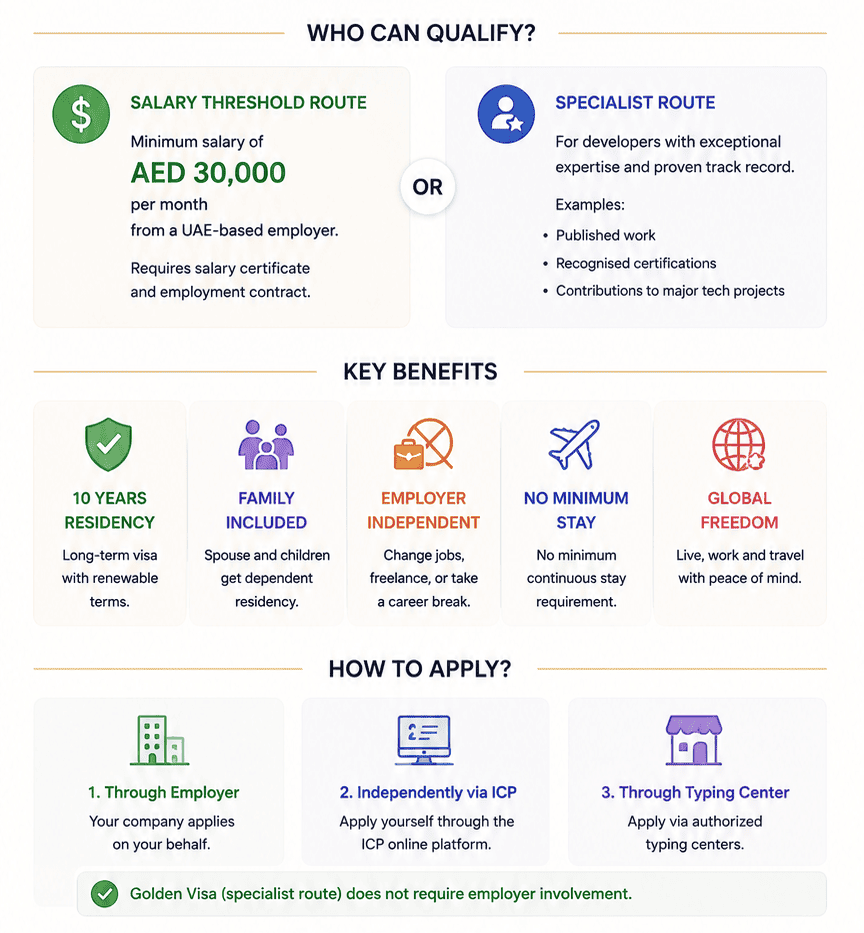
The Golden Visa for tech professionals works as follows:
The primary qualifying route for developers is salary threshold: a minimum of AED 30,000 per month from a UAE-based employer, confirmed via salary certificate and employment contract. An alternative route exists for specialists who can demonstrate exceptional expertise through published work, recognised professional certifications, or documented contributions to significant tech projects - this route is more subjective and requires supporting evidence but opens the door for senior developers below the salary threshold. The visa is valid for 10 years with renewable terms. Immediate family members - spouse and children - receive dependent residency automatically under the same application. There is no minimum continuous stay requirement to maintain validity, which makes it workable for developers who travel extensively or spend significant time outside the UAE.
The application can be filed through your employer, independently through the ICP (Federal Authority for Identity, Citizenship, Customs and Port Security) platform, or via authorised typing centres. Unlike the Employment Visa, the Golden Visa does not require employer involvement if you're applying on the specialist track.
Processing timeline: 4-8 weeks for straightforward applications with clear salary documentation. Specialist track applications that require evidence review can run 8-12 weeks. The government fee is approximately AED 2,800 for the primary applicant; dependent applications add approximately AED 1,000 per person.
Freelance Permit - For Independent Frontend Developers
If you're considering Dubai as a base for freelance frontend work - whether serving local UAE clients, international clients remotely, or a combination of both - the Freelance Permit is the mechanism that makes it legal and sustainable. This is a distinct legal structure from both the Employment Visa and the Golden Visa, and it's genuinely well-suited to the way many experienced frontend developer freelance Dubai professionals now structure their work.
The core difference from an Employment Visa is that a Freelance Permit allows you to work with multiple clients simultaneously under your own name, invoice directly, and operate as a self-employed resident - without needing a corporate sponsor or a single employer anchor. It's issued through one of the UAE's Free Zones, each of which has slightly different pricing, processing times, and permitted activity lists.
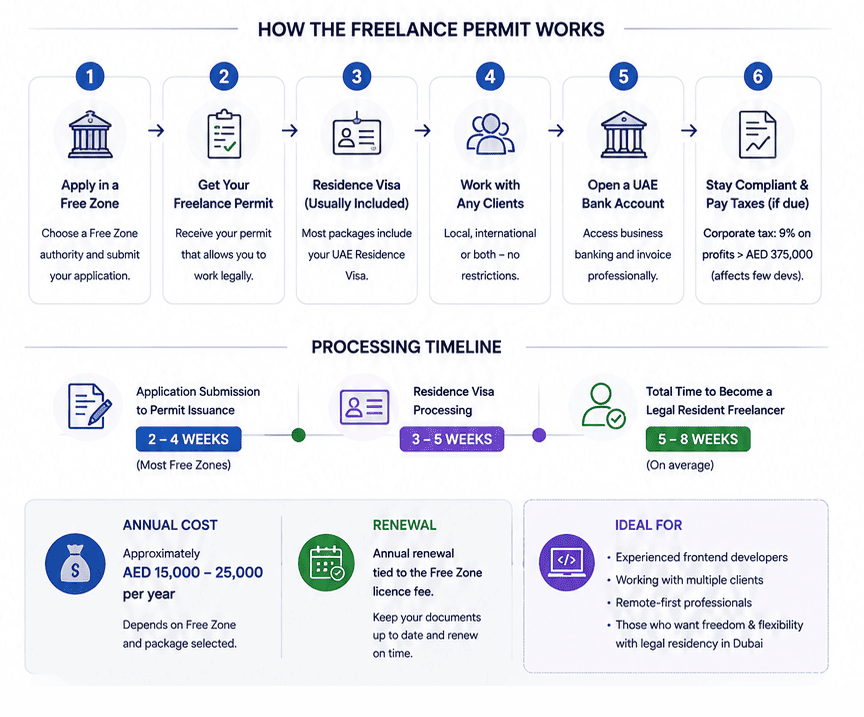
The Freelance Permit structure works as follows:
You apply through a Free Zone authority - IFZA (International Free Zone Authority), Dubai Silicon Oasis, and Meydan Free Zone are the most commonly used by IT professionals, with annual costs ranging from approximately AED 15,000 to AED 25,000 depending on the zone and package. The permit covers your legal right to work as a freelancer, and in most cases also provides the basis for a UAE Residence Visa, allowing you to live in Dubai as a self-employed resident. You can work with an unlimited number of clients - local UAE businesses, international companies, or direct consumers - without restriction. A UAE business bank account becomes accessible once you hold the permit, which matters significantly for professional invoicing and receiving international transfers. The corporate tax introduced in 2023 (9% on annual profits exceeding AED 375,000) affects very few freelance developers in practice - the threshold is high, and most independent developers operating at typical market rates remain well below it.
The one area where freelance permit holders regularly encounter friction is banking. UAE banks apply their own income verification standards, and a freelance permit without a consistent transaction history can make mortgage applications, car finance, or even some types of savings accounts harder to access. Maintaining a parallel account with Wise or a similar international banking service during the first year resolves most of this practically.
Processing timeline: 2-4 weeks from application submission to permit issuance for most Free Zone applications, assuming documentation is complete. Residence Visa processing adds another 3-5 weeks. Total time from starting the application to being a legal resident freelancer: approximately 5-8 weeks. Renewal is annual, tied to the Free Zone licence fee.
Where to Find Frontend Developer Jobs in Dubai: Companies and Platforms
The Dubai job market has a specific rhythm that catches a lot of developers off guard. Applications sent cold into a job board void rarely convert. The market here runs significantly on referrals, on LinkedIn visibility, and on the kind of informal professional relationships that get built at industry events and in co-working spaces. That doesn't mean job boards are useless - they're not - but understanding which platforms carry real weight in this specific market, and why, changes how you allocate your search effort.
One thing worth saying upfront: the Dubai frontend job market is not homogeneous. There's a meaningful difference between the hiring environment at a fast-scaling fintech in DIFC, a regional e-commerce company in a free zone, a digital agency serving government clients, and an international tech company with a UAE office. Each has different hiring timelines, different interview processes, different compensation structures, and different day-to-day realities. Knowing which type of employer you're targeting before you start searching makes the whole process more efficient.
Top Companies Hiring Frontend Developers in Dubai
Dubai has a strong market for frontend talent, with openings across fintech, e-commerce, beauty, logistics, and tech. Current job boards show active frontend hiring from companies such as Binance, Huda Beauty, Midis Group, and other employers listed on Dubai-specific job platforms.
| Company | Why it stands out | Open frontend role / company link |
| Binance | Actively hiring senior frontend talent in Dubai, including stablecoin-related product work. | Frontend jobs at Binance in Dubai |
| Huda Beauty | Strong e-commerce and Shopify frontend needs, with frontend roles listed in Dubai. | Frontend jobs at Huda Beauty in Dubai |
| Midis Group | Enterprise and digital products, with frontend openings in Dubai. | Frontend jobs at Midis Group in Dubai |
Where to Actually Search
- LinkedIn is non-negotiable for the Dubai market in a way that goes beyond most other cities. UAE hiring managers and recruiters are unusually active on the platform, and a well-optimised profile - one that clearly signals React and TypeScript experience, shows UAE timezone availability, and has recent activity - generates inbound recruiter contact at a meaningful rate for mid-to-senior developers.
- Bayt.com is the dominant job platform for the MENA region and carries significant volume of local UAE listings that don't appear on LinkedIn or global boards. Many UAE-headquartered companies post exclusively or primarily on Bayt, particularly in the mid-market.
- GulfTalent positions itself at the senior and specialist end of the market and tends to carry higher-quality listings with more complete compensation information than most regional platforms. For developers at the five-plus years of experience mark, it's worth a dedicated search rather than treating it as an afterthought.
- Naukrigulf has a large user base drawn heavily from South Asian expat professionals and tends to surface roles from companies actively hiring from that talent pool - which, practically speaking, includes a significant portion of Dubai's mid-market tech employers.
- Indeed is one of the most comprehensive platforms for finding Frontend Developer jobs in Dubai, offering a large volume of active listings across companies of all sizes. Indeed also aggregates postings from multiple sources, including company career pages and job boards, so you often see more openings here than on other platforms. The interface is straightforward, and you can set up email alerts for new frontend vacancies in Dubai.
- Wellfound is a great platform if you’re interested in startup-style frontend jobs in Dubai, especially with early-stage or high-growth companies. The platform emphasizes company culture and mission, so you can see if a startup aligns with your values before applying. Wellfound also shows salary ranges and equity options, which is rare for Dubai listings.
- Crossover is a unique platform that specializes in high-paying, structured remote and Dubai-based roles, often with multinational companies. It targets experienced frontend developers who are comfortable with rigorous hiring processes and performance-driven environments. Many Crossover positions in Dubai require strong technical skills and often come with competitive salaries, sometimes above market average. The platform focuses on long-term, full-time roles rather than short-term contracts, and it often includes detailed job descriptions with clear expectations.
For remote-adjacent opportunities - international companies that allow Dubai-based employees to work for primarily European or US clients from a UAE base - Remotive, We Work Remotely, and Toptal are worth monitoring. The timezone (UTC+4) works well for European collaboration and reasonably well for morning overlap with US East Coast, which makes Dubai a practical base for remote work in a way that some other expat destinations aren't.
Why It's Difficult:
- The employer bears real cost to hire you. Visa sponsorship, medical tests, Emirates ID processing - the company spends AED 3,000-6,000 before you write a single line of production code. That creates a bias toward candidates with a track record, even a short one.
- The candidate pool is global and deep. Dubai's openness as an expat hub means junior roles attract applications from dozens of countries simultaneously. A mid-sized tech company posting an entry-level frontend position in 2026 can expect 200-400 applications within a week, a significant proportion from candidates with more experience than the role technically requires.
- Stack expectations have shifted upward. What counted as a solid junior profile three years ago - HTML, CSS, vanilla JavaScript, maybe some React basics - is now the floor, not the differentiator. Companies hiring junior developers in Dubai in 2026 expect React fluency, at least working knowledge of TypeScript, and familiarity with Git workflows and basic CI/CD concepts. Candidates who arrive with only foundational web skills find themselves filtered out before the first conversation.
- Networking infrastructure takes time to build. The referral advantage that accelerates job searches for experienced developers doesn't exist yet for someone arriving fresh. Without local professional relationships, you're entirely dependent on cold applications - the lowest-conversion channel in a high-referral market.
- Salary expectations create a structural mismatch. The practical cost of living in Dubai - rent, food, transport, insurance - creates a floor of around AED 6,000-7,000/month just to break even. Some companies offer junior roles at AED 5,000-6,000 as a starting point, which is financially untenable for most expats without a financial buffer. This narrows the viable portion of the junior market further.
What Really Helps You Land Your First Frontend Developer Job in Dubai as a Fresher
Finding your first frontend developer job in Dubai as a fresher is challenging but achievable with the right strategy. The Dubai market values practical skills, visible projects, and local networking over formal credentials alone. Entry-level IT roles are scarce, so you need to stand out through targeted actions that prove you can deliver real work. The most effective approach combines building a strong portfolio, optimizing your LinkedIn profile, applying to UAE-focused job boards, and actively networking with Dubai-based developers and recruiters. Many employers prefer candidates already in the UAE due to visa sponsorship costs, but remote junior roles do exist.
Key Actions That Work for Freshers
| Action | Why it helps | How to implement |
| Build 3-5 real frontend projects | Shows you can ship working code, not just tutorials | Create React/TypeScript projects with deployed demos on Vercel/Netlify, link them on your resume and LinkedIn |
| Optimize LinkedIn for Dubai | Recruiters search LinkedIn daily for frontend talent | Add Frontend Developer's Skills |
| Apply to Naukrigulf + Bayt | These platforms focus on UAE employers who hire freshers | Search "Junior Frontend Developer" and "Fresher Web Developer" Daily, apply within 24 hours of posting |
| Join Dubai tech communities | Networking unlocks hidden entry-level opportunities | Join Telegram channels like "WorkingDubai" #IT, attend Dubai Dev Meetups, comment on local tech posts |
| Target startups via Wellfound | Startups hire freshers more often than big companies | Filter for "Junior" or "Entry Level" frontend roles, apply directly to founders on Wellfound |
| Learn React + TypeScript + CSS | These are the most in-demand frontend skills in Dubai | Complete 1-2 advanced courses, build projects using these exact tech stacks, mention them in every application |
| Get certifications or bootcamp credentials | Validates your skills when you lack work experience | Consider recognized programs like Yandex Practicum, Codemia, or local UAE bootcamps with hiring partnerships |
| Consider remote-first companies | Remote roles don't require visa sponsorship initially | Apply to companies hiring remote junior frontend developers in UAE, then transition to on-site after gaining experience |
Practical Tips for Your Application
- Customize your resume for each role - Match the job description keywords (React, TypeScript,HTML, CSS, JavaScript, Next.js) and highlight your deployed projects.
- Apply early and frequently - Freshers should aim for 10-20 applications per week across Indeed, Naukrigulf, Bayt, and LinkedIn.
- Follow up with recruiters - After applying, send polite messages on LinkedIn to hiring managers or recruiters at the company.
- Be realistic about visa requirements - Many companies hesitate to sponsor juniors due to costs. If possible, consider arriving in Dubai first or targeting companies known to sponsor visas.
Dubai is not an easy place for entry-level jobs, and experience from recognized firms abroad is more rewarding in the Dubai market. Entry-level positions are scarce, so you may need to start with remote work, freelance projects, or internships to build your resume before landing a full-time frontend. Focus on specializing in one discipline (frontend), study consistently, work on pet projects using market-demand technologies, and add these skills prominently to your LinkedIn profile and resume.
Frequently Asked Questions About Frontend Developer Jobs in Dubai
Do I need to speak Arabic to work as a frontend developer in Dubai?
No. English is the working language of Dubai's tech industry without exception. The overwhelming majority of product companies, startups, and international organisations operating in the UAE run entirely in English - team meetings, code reviews, documentation, Slack channels, performance reviews. Arabic gives you a genuine cultural advantage and signals respect for the local context, and learning a few dozen words of conversational Arabic is worth doing as a professional courtesy. But treating it as a prerequisite for a frontend career in Dubai would disqualify almost the entire expat developer population, which makes up the vast majority of the technical workforce.
Can I bring my family to Dubai on an Employment Visa?
Yes, with important financial caveats that most guides bury in the small print. The formal salary threshold for sponsoring dependents is AED 4,000/month, but that number bears almost no relationship to what it actually costs to live here as a family. A realistic minimum for a couple with one school-age child is AED 22,000-25,000/month - once you factor in international school fees (AED 20,000-50,000 per year depending on curriculum and school tier), a larger apartment, and the generally higher cost of family life in Dubai.
Your spouse receives a Dependent Visa and has the legal right to work in the UAE, which meaningfully changes the household income picture if they find employment. Children under 18 are covered under your sponsorship. The family move works well financially at senior compensation levels; at mid-level, it requires careful budgeting and realistic expectations.
Is it true there are really no taxes in Dubai?
Mostly true for salaried employees, with three qualifications worth knowing. Personal income tax does not exist in the UAE - your gross salary is your take-home salary, and that applies to every nationality, including those whose home countries typically tax worldwide income (check your own country's rules on foreign-earned income before assuming complete tax freedom). VAT at 5% was introduced in 2018 and applies to most goods and services, so your cost of living reflects it whether you notice it or not. Corporate tax at 9% on annual profits above AED 375,000 was introduced in 2023 and applies to freelancers and business owners - not to salaried employees.
How long does it realistically take to find a frontend job in Dubai?
It varies considerably by seniority and preparation, but realistic timelines based on current market conditions look roughly like this. A mid-level developer with React and TypeScript experience, an optimised LinkedIn profile, and active job searching should expect 4-10 weeks from starting the search to signed offer. Senior developers with a strong portfolio and specific domain experience - fintech, proptech, e-commerce - typically move faster, often 3-6 weeks, because the candidate pool thins out meaningfully at that level.
Junior developers without UAE work experience should budget 2-4 months minimum, and longer if they're relying solely on job board applications without networking activity. These timelines assume you're actively applying, following up, and engaging with the Dubai tech community - not submitting applications and waiting.
What happens to my visa if I lose my job?
Your residence visa enters a grace period - 30 days under standard Employment Visa conditions, though recent regulatory updates have extended this to 60 days in some categories. During this window you can legally remain in the UAE while pursuing a new employer sponsor, switch to a Freelance Permit if you intend to go independent, or depart the country.
Overstaying the grace period incurs daily fines that accumulate quickly and create complications for future UAE entry. The practical implication is that you should maintain enough financial reserves to cover 2-3 months of living expenses at all times - not as paranoia, but as basic risk management in a system where your residency and your employment are structurally linked.
Is Dubai safe for solo expats and international developers?
Consistently and measurably yes. Dubai ranks among the top ten safest cities globally by multiple indices measuring violent crime, street safety, and personal security. The practical experience for most expat developers - including those living alone, women included - is a level of day-to-day safety that compares favourably with most major European cities. The cultural environment requires some adjustment: alcohol is available but only in licensed venues, public displays of affection are subject to local law, and Ramadan brings observable changes to working hours and social norms.
Can I do freelance work on the side while employed full-time in Dubai?
Not legally without a separate permit. Your Employment Visa authorises you to work specifically for your sponsoring employer. Taking on paid freelance clients - even international ones, even remotely - without a Freelance Permit constitutes unauthorised work under UAE labour law. Some developers do it quietly, but the risk is real: contract termination and visa cancellation if discovered. The cleaner path is to either obtain a Freelance Permit in parallel with your employment (some free zones allow this; check the specific terms) or to negotiate a side-project clause into your employment contract. The latter is more common than people realise. Some Dubai employers, particularly in the startup space, are open to it for non-competing work.
What is the interview process like at Dubai tech companies?
It varies by company type but follows recognisable patterns. International product companies and well-funded startups tend to run processes close to what you'd encounter in Europe or the US: recruiter screen, technical assessment or take-home project, one or two technical interviews covering JavaScript fundamentals and frontend architecture, and a culture or team-fit conversation. Timelines at these companies typically run 2-4 weeks from first contact to offer.
Local and regional companies often move faster - 1-2 weeks is common - with less structured technical assessment and more weight on portfolio review and in-person chemistry. Agency hiring is typically the fastest and least formal. One consistent difference from European markets: salary negotiation in Dubai is more openly transactional and less awkward. Know your number, state it clearly, and expect a direct conversation about it.