
Frontend Developer Jobs Netherlands 2026: Visa, 30% Ruling & Top Companies
27 May 2026
241 views
This guide is up to date as of August 2026

Written by
Marcus Hale,
IT Talent Acquisition Specialist

Reviewed by
Eva van Dijk,
IT Talent Acquisition Specialist, Netherlands
Every month, hundreds of frontend developer positions go live across Amsterdam, Rotterdam, and Utrecht - yet a significant share of them never get filled by the right candidate. Not because talent is scarce, but because most developers outside the Netherlands don't know how the local job market actually works: which companies hire internationally, what tech stacks dominate, how the visa process unfolds, and what financial advantage awaits you the moment you sign a contract with a Dutch employer.
One of those advantages - the 30% ruling - is arguably the most underrated financial benefit available to any expat tech worker in Europe. It's not a perk. It's a legally structured tax exemption that can put an extra €700-€1,000 in your pocket every single month.
Why the Netherlands?
The Netherlands has spent the last decade quietly becoming one of Europe's most reliable destinations for tech talent - not through aggressive marketing, but through structural advantages that keep compounding. In 2026, those advantages are more tangible than ever for frontend developers specifically.
- English Is the Default, Not the Exception. Unlike Germany or France, where language barriers remain a genuine obstacle even in tech roles, the Netherlands operates almost entirely in English at the corporate level. This isn't just a startup phenomenon - multinationals, scale-ups, and even mid-sized Dutch product companies run their engineering teams, sprint planning, code reviews, and documentation in English. For a frontend developer relocating from Ukraine, Brazil, India, or anywhere outside the EU, this removes one of the biggest friction points of building a career abroad.
- A Concentration of Product Companies, Not Just Outsourcing. What makes the Dutch market structurally different from, say, Poland or Romania is the density of actual product companies headquartered here. Booking.com, Adyen, TomTom, WeTransfer, Mollie, bol.com - these aren't client-service firms or outsourcing shops. They build their own products, maintain their own codebases, and need frontend engineers who take genuine ownership of the user experience. That translates into more senior-level opportunities, more interesting technical challenges, and more stable long-term employment compared to markets dominated by IT consulting.
- The EU Location Advantage. For developers who want access to the broader European job market without committing to a single country forever, the Netherlands is a strategically smart entry point. A Highly Skilled Migrant visa (Kennismigrant) here doesn't trap you - it builds toward permanent residency in five years, and the Dutch government has historically been one of the more straightforward EU countries to navigate on immigration paperwork. The country also sits in CET/CEST, making collaboration seamless with teams across all of Western Europe and manageable with East Coast US counterparts.
- Startup Ecosystem Without the Instability. Amsterdam consistently ranks among the top five European startup ecosystems by investment volume. That matters for frontend developers not because startups necessarily pay more - they often don't - but because they tend to move faster on hiring decisions, offer more varied technical scope, and provide the kind of CV-building experience that opens doors later. Companies like Mollie, MessageBird (now Bird), and Takeaway have all scaled into unicorns from Amsterdam, and each wave of growth creates new senior and lead frontend roles that didn't exist a year prior.
Amsterdam Is Not the Only Game in Town. Most developers default to searching Amsterdam - and they're right that it concentrates the highest volume of frontend roles. The Zuidas business district and Amsterdam Science Park alone account for a significant share of senior and medior positions. But the wider picture is richer:
- Rotterdam has undergone a quiet but meaningful tech transformation. The Lloydkwartier and the port-adjacent innovation zones have attracted a growing cluster of logistics tech, fintech, and e-commerce companies that actively recruit frontend talent - often at lower competition than Amsterdam, with meaningfully lower living costs.
- Utrecht sits almost exactly between Amsterdam and Rotterdam on the rail line and has become a preferred base for developers who want proximity to both markets. bol.com, the largest online retailer in the Netherlands and Belgium, is headquartered here - and it runs one of the country's most active frontend engineering teams.
- Eindhoven rounds out the picture with a different profile: ASML, the semiconductor equipment giant, and Philips' technology division anchor a deep engineering culture that leans toward Angular and TypeScript-heavy enterprise stacks. It's not the obvious first stop for a React developer, but for the right profile it offers exceptional stability and above-average compensation.
The combination of product-first companies, genuine English-language integration, multiple viable cities, and a government-backed tax incentive for foreign hires creates a job market that rewards frontend developers who do their research and approach it deliberately. The next sections cover exactly how to do that.
Frontend Developer vacancies in the Netherlands, 2026
As of 2026, the Netherlands has a strong market for Frontend Developer roles, with job counts varying by platform. LinkedIn shows 196 Front-end Development jobs in the Netherlands, Indeed shows 800+ Front End Developer vacancies in the Netherlands, and Glassdoor lists 939 frontend jobs in the country.
- Amsterdam: LinkedIn shows roles such as Frontend Developer (React) in Amsterdam, Built In lists frontend jobs in Amsterdam, and Glassdoor shows 246 open frontend developer jobs in Amsterdam.
- Utrecht: Built In lists senior frontend roles in Utrecht, indicating active demand there.
- Den Haag: LinkedIn includes Front-end Developer roles in Den Haag.
- Leiden: LinkedIn also shows Medior Frontend Developer roles in Leiden.
- Rotterdam: Glassdoor shows 18 front end developer relocation jobs in Rotterdam.
Frontend Developer Salaries in the Netherlands 2026
Salary ranges in the Dutch tech market are wide - and for good reason. The gap between a junior developer at a Rotterdam e-commerce startup and a senior engineer at Adyen or Booking.com isn't just about years of experience. It reflects the type of company, the complexity of the product, whether you're working in a niche stack, and critically, whether you're factoring in the 30% ruling that effectively restructures your take-home pay from day one.
The figures below are drawn from SheCodes 2026, Glassdoor Netherlands, LinkedIn Salary Insights, and Talent.io data as of May 2026. Where sources diverged, we've used the median of verified data points rather than outliers. Glassdoor in particular tends to underrepresent Dutch salaries due to low submission volume - cross-referencing with Honeypot.io and devitjobs.nl gives a more accurate picture for the Amsterdam and Rotterdam markets specifically.
One pattern stands out consistently across sources: TypeScript proficiency, test coverage familiarity, and the ability to work within design systems add measurable salary uplift at every level - not just senior. Dutch companies are increasingly hiring for long-term product ownership, not just feature delivery, and compensation reflects that expectation. The table below covers gross annual figures before tax and before applying the 30% ruling.
| Level / Location | Annual salary estimate |
| Netherlands, entry-level | €31,947 total compensation |
| Netherlands, mid-level | €46,432 average base salary |
| Netherlands, senior | Up to €76,000 total compensation |
| Netherlands, junior | €42,436-€63,654 |
| Netherlands, mid-level | Around €79,568 |
| Netherlands, senior | €95,481-€137,917+ |
| Amsterdam | €48,000-€77,500 |
| Amsterdam, average | €63,900 |
| Utrecht | €45,000-€78,000 |
| Utrecht, average | €61,200 |
| Rotterdam | $64k-$86k and $98k-$132k by level |
This table is built from these 2026 salary sources: PayScale for national salary estimates, QuickSalaries for nationwide junior/mid/senior ranges, DevITjobs.nl for city-level estimates in Amsterdam and Utrecht, and Elitics for Rotterdam salary bands.
Salaries by Technology Stack
Based on analysis of 100+ active frontend job postings across LinkedIn and Glassdoor Netherlands:
- React + TypeScript - the dominant market stack, present in over 75% of Amsterdam frontend listings. Developers with three or more years of production React experience combined with strong TypeScript consistently sit at the top of the medior range and entry of senior. Salary premium of roughly 15-20% over vanilla JavaScript profiles.
- Angular + TypeScript - primary stack in enterprise environments: fintech, logistics, large-scale e-commerce. High demand in Rotterdam and Eindhoven specifically. Senior Angular engineers with RxJS depth and enterprise architecture experience command €90,000-€115,000 at companies like ASML, ING, and Philips Tech.
- Next.js / fullstack-leaning frontend - growing rapidly as Dutch product companies reduce the boundary between frontend and backend responsibilities. Developers comfortable with SSR, API routes, and basic Node.js are increasingly preferred over pure frontend profiles at the medior level. Salary uplift of €5,000-€10,000 annually compared to equivalent React-only experience.
- Vue.js - less prevalent than React but maintains steady demand in mid-size product companies and scale-ups. Salaries broadly comparable to React at junior and medior levels, with a thinner senior market. Vue is more common in Utrecht and smaller Amsterdam studios than in the corporate tech cluster.
- Web3 / Blockchain frontend - niche but consistently high-paying. Amsterdam retains one of Europe's more active blockchain development communities, and senior frontend engineers with Web3 integration experience (ethers.js, wagmi, wallet connectivity) regularly see offers between €120,000 and €150,000. Demand is volatile but compensation when hiring happens is well above market.
- React Native / cross-platform - moderate demand, primarily from product companies that maintain both web and mobile surfaces under one team. Treated as a specialisation premium: developers who can cover both web React and React Native are hired at senior compensation even with medior years of experience.
30% Ruling: The Tax Advantage That Makes the Netherlands Genuinely Different
If you've been comparing European tech markets purely on gross salary, you've been looking at the wrong number. The Netherlands has a legal mechanism - the 30% ruling - that materially changes what you actually take home each month, and it applies specifically to foreign specialists relocating for work. No other country in the EU offers anything quite like it at this scale and accessibility.
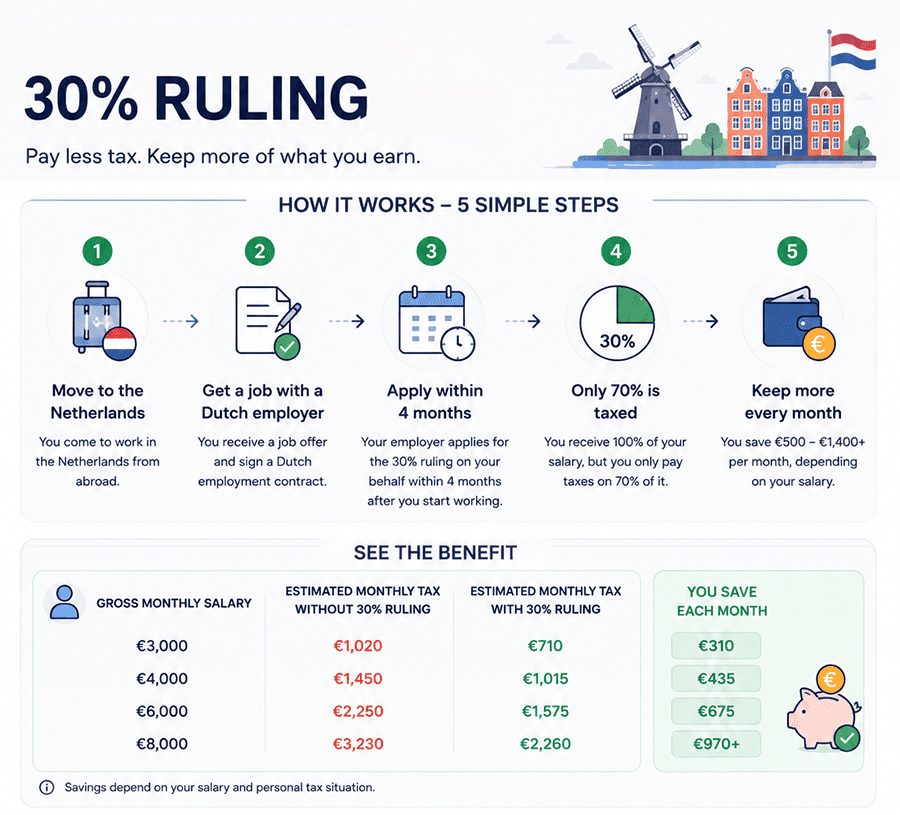
The 30% ruling (officially: 30%-regeling) is a Dutch tax facility that allows your employer to pay 30% of your gross salary as a tax-free allowance.
In practice, this means only 70% of your gross income is subject to Dutch income tax. The remaining 30% is treated as compensation for the extra costs of relocating and living abroad - and the government doesn't tax it. This isn't a deduction you claim at the end of the year. It's applied directly to your monthly payroll, which means the benefit shows up in every single paycheck from your first month of employment.
The Partial Non-Residency Option
There's a less-discussed layer to the 30% ruling that can be particularly valuable for developers with savings, investments, or property outside the Netherlands.
When you hold the 30% ruling, you can elect to be treated as a partial non-resident for Dutch tax purposes. This means you pay Dutch income tax on your salary (box 1), but you're exempt from Dutch wealth tax (box 3) on assets held outside the Netherlands. For someone with a brokerage account, foreign property, or significant savings in another country, this can represent substantial additional savings that have nothing to do with your salary level. This election must be made explicitly in your annual Dutch tax return. It doesn't happen automatically, and many expats who hold the ruling are unaware it exists.
Abstract percentages are hard to feel. Here's what the 30% ruling means at different salary levels, calculated against the Dutch income tax rate of approximately 36.97% on income up to €75,518 and 49.5% above that threshold (2026 rates):
| Gross Annual Salary | Tax Without Ruling | Tax With Ruling | Monthly Saving |
| €55,000 | ~€18,700 | ~€12,400 | ~€525/month |
| €70,000 | ~€25,200 | ~€16,600 | ~€717/month |
| €90,000 | ~€36,200 | ~€23,900 | ~€1,025/month |
| €120,000 | ~€54,800 | ~€37,200 | ~€1,467/month |
These are approximate figures based on box 1 income tax only, before social contributions and other deductions. The point isn't precision - it's order of magnitude. At a €70,000 salary, the 30% ruling is worth roughly the same as a €8,600 gross salary increase. At €90,000, it exceeds a €12,000 raise. No negotiation required - it's built into the system.
Who Qualifies: The Exact Conditions in 2026
The ruling isn't automatic, and not every foreign hire qualifies. The conditions are specific:
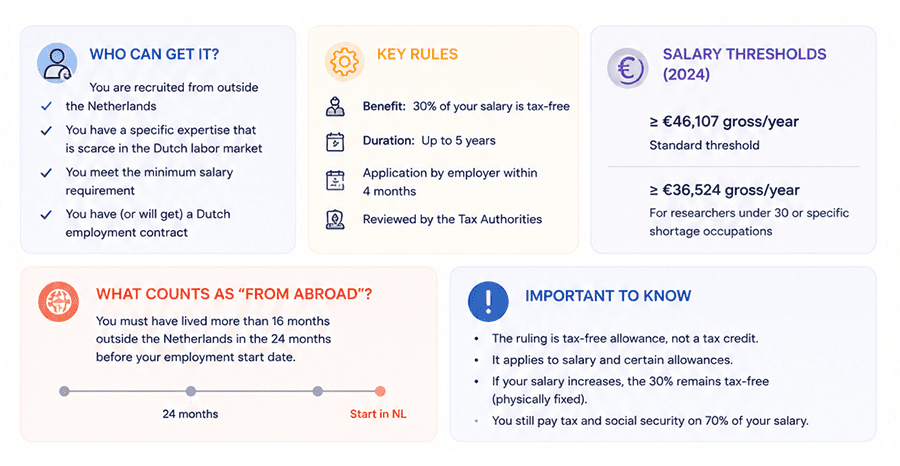
- Residency requirement. You must have lived outside the Netherlands for at least 16 of the 24 months immediately before your first Dutch working day. If you spent significant time in the Netherlands before starting your role - studying, doing contract work, or even living within 150 kilometres of the Dutch border - this can disqualify you. The 150km rule catches many developers relocating from Belgium, western Germany, or northern France.
- Salary threshold. In 2026, your gross annual salary must be at least €46,107 to qualify. For professionals under 30 with a master's degree, the threshold is lower: €35,048. These thresholds are adjusted annually, so verify the current figure with your employer or a Dutch tax adviser at the time of application.
- Dutch employer. The ruling only applies to income earned from a Dutch employer. If you're working remotely for a foreign company while living in the Netherlands, you don't qualify - regardless of where you pay tax.
- Application deadline. This is the detail that costs people real money: you must submit the application within four months of your first working day. Miss this window and the benefit is gone permanently for that employment contract. There are no extensions, no retroactive applications, no exceptions. Build this into your relocation checklist from day one.
What Changed: The 2024 Reform You Need to Know
Until 2024, the 30% ruling lasted seven years. That changed. From January 2024, the maximum duration is five years - full stop, no extensions, no grandfathering for most existing claimants. Additionally, since 2024 the ruling is subject to the Balkenende norm - a cap tied to the maximum salary in the public sector (approximately €246,000 in 2026). For the vast majority of frontend developers this cap is irrelevant, but for senior engineers negotiating equity-heavy packages at top-tier companies, it's worth being aware of.
A phased reduction that was briefly legislated - where the 30% applied only for the first 20 months, then dropped to 20%, then 10% - was reversed before taking full effect. As of 2026, the flat 30% applies for the full five-year duration. This reversal came after significant lobbying from Dutch employers and expat communities, and it's one of the reasons the ruling remains one of Europe's most competitive expat tax incentives despite the duration cut.
Practical Steps: How to Actually Get It
The process involves your employer more than it involves you, but you need to drive it:
First, confirm before signing your contract that your employer is registered with the Dutch Tax Authority (Belastingdienst) and is willing to apply for the ruling on your behalf. Most established Dutch tech companies do this routinely - but smaller startups occasionally need prompting.
Second, get your BSN (Burgerservicenummer - the Dutch equivalent of a tax identification number) within your first week. You obtain this by registering at your local municipality (gemeentehuis). Without a BSN, the ruling application cannot be submitted. Book this appointment before you even land if possible, as slots in Amsterdam municipalities can run two to three weeks out.
Third, your employer files the joint application with the Belastingdienst, supported by documentation of your previous foreign residence. Processing typically takes six to ten weeks. The benefit is applied retroactively to your start date once approved, so there's no financial loss during the waiting period.
Fourth, if you change employers within your five-year window, the ruling transfers - but you must apply again with your new employer, and the combined duration cannot exceed the original five years. Keep track of exactly when your ruling started.
One Honest Caveat
The 30% ruling is a significant financial benefit, but it interacts with other parts of the Dutch tax and social security system in ways that aren't always obvious. Pension contributions, mortgage interest deductions, and partner income can all affect the net picture. Before you sign a contract or make relocation decisions based on the ruling alone, a single consultation with a Dutch tax specialist (belastingadviseur) - many of whom work specifically with expat tech workers - costs €100-€200 and can save you from assumptions that cost considerably more.
Visa Routes for Frontend Developers Relocating to the Netherlands
The visa question is where many developers stall - not because the process is genuinely complicated, but because the information available online is fragmented, often outdated, and frequently conflates different permit types. This section covers the three realistic routes for frontend developers in 2026, what each actually requires, and how they interact with the 30% ruling and the broader relocation process.
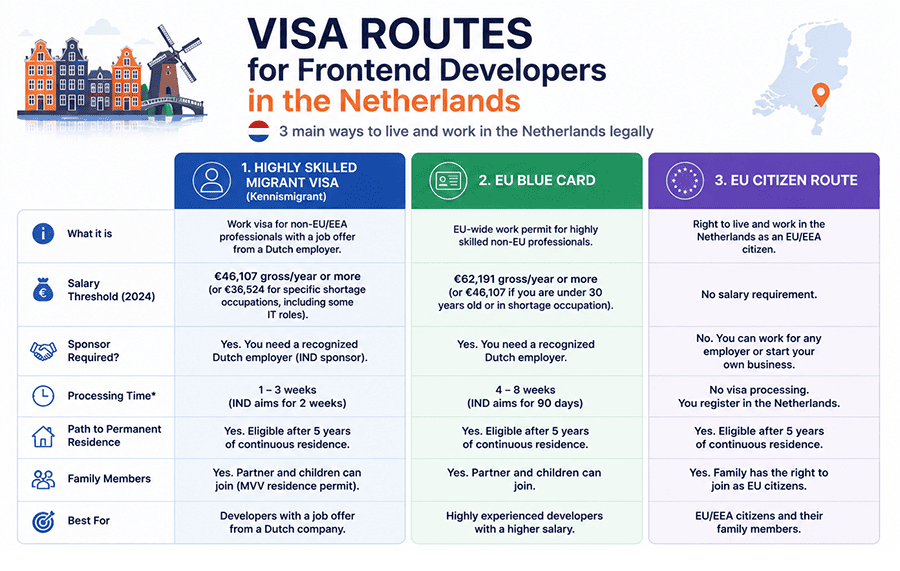
One important framing note before the details: the Netherlands processes tech worker visas relatively efficiently compared to other EU countries, particularly when the employer is already a recognised sponsor. The bottleneck is almost never the government - it's developers waiting too long to start the process, or employers unfamiliar with their own obligations.
Route 1: Highly Skilled Migrant Visa (Kennismigrant)
This is the primary permit for frontend developers relocating from outside the EU and EEA. It's employer-sponsored, salary-gated, and when conditions are met, processed faster than almost any equivalent permit in Western Europe.
How it works. Your Dutch employer applies to the IND (Immigratie- en Naturalisatiedienst - the Dutch Immigration and Naturalisation Service) on your behalf. You don't apply independently. The employer must hold recognised sponsor status (erkend referent) - a designation the IND grants to companies that hire international talent regularly and meet compliance standards. Most established Dutch tech companies hold this status. Startups and smaller studios sometimes don't, which is worth verifying before you get deep into an interview process.
Salary thresholds in 2026. The minimum qualifying salary is €46,107 gross per year for applicants aged 30 and above. For applicants under 30, the threshold is €33,721. These figures are adjusted annually in January, so if you're planning a move later in the year, confirm the current threshold directly with the IND or your employer's HR team. The salary requirement is assessed on your base contract salary - bonuses, equity, and allowances are typically excluded from the calculation.
Processing time. When the employer holds recognised sponsor status, the IND targets a two-week processing window. In practice, straightforward applications with complete documentation often come through within that timeframe. Complex cases or incomplete submissions can extend to four to six weeks. Without recognised sponsor status, the standard processing time is ninety days - a meaningful difference if you're trying to coordinate a start date.
What you receive. The Kennismigrant permit is issued as a residence permit (verblijfsvergunning) with an initial duration tied to your employment contract, up to a maximum of five years. Your partner or spouse receives a dependent permit that includes unrestricted work rights - they can take employment or start a business without a separate work permit application. Dependent children under eighteen are included in the family permit.
Path to permanent residency. After five consecutive years of legal residence in the Netherlands, you can apply for a permanent residence permit (verblijfsvergunning voor onbepaalde tijd) or EU long-term residence status. The five-year clock starts from your first day of registered residence, not from permit approval. Registration at your municipality on arrival therefore matters more than most developers realise.
One practical note on timing. The IND process cannot begin until you have a signed employment contract. This means the two-week processing window starts later than most developers expect. Factor in: offer negotiation, contract signing, IND application submission, permit processing, and physical relocation - and a realistic timeline from first offer to first working day in the Netherlands is six to ten weeks for an uncomplicated case.
Route 2: EU Blue Card
The EU Blue Card is the pan-European alternative to the Kennismigrant, designed to create a more portable skilled worker status across EU member states. In the Netherlands it runs in parallel with the Kennismigrant system rather than replacing it, and for most frontend developers the practical differences are worth understanding before choosing.
Salary threshold. The Blue Card requires a higher minimum salary than the Kennismigrant: €60,000 gross per year in the Netherlands in 2026. This puts it out of reach for most junior and early medior profiles, but well within range for senior frontend developers and those targeting larger tech companies.
Qualification requirement. Unlike the Kennismigrant, the Blue Card formally requires a higher education qualification - a degree of at least three years' duration, or recognised equivalent professional experience. For self-taught developers or those with non-traditional backgrounds, this can be a genuine barrier. The Kennismigrant has no formal degree requirement as long as the salary threshold is met.
The mobility advantage. The Blue Card's primary practical benefit activates after eighteen months of holding the permit in the Netherlands: at that point, you can move to work in another EU member state significantly more easily than with a national permit. For a developer who sees the Netherlands as a stepping stone into the broader EU market - or who has offers from companies in multiple countries - this is a meaningful structural advantage.
Processing. The Blue Card goes through the same IND infrastructure as the Kennismigrant and benefits from the same recognised sponsor fast-track. Processing timelines are broadly comparable.
Honest assessment. For most frontend developers relocating specifically to the Netherlands with a concrete employer in place, the Kennismigrant is simpler, has a lower salary threshold, and gets you the same residence rights. The Blue Card makes more sense if you actively plan to move within the EU within a few years, or if your employer specifically recommends it based on their internal processes.
Route 3: EU/EEA Citizens - No Permit Required
Citizens of EU member states, EEA countries (Norway, Iceland, Liechtenstein), and Switzerland have the right to live and work in the Netherlands without any permit. There is no application, no sponsor requirement, and no salary threshold.
The practical obligation is registration. If you intend to stay in the Netherlands for more than four months, you must register at your local municipality (gemeente) within five days of arriving. This registration creates your entry in the Personal Records Database (Basisregistratie Personen) and triggers the issuance of your BSN. Without a BSN you cannot open a Dutch bank account, sign a rental contract through most legitimate agencies, receive salary, or apply for the 30% ruling.
For EU citizens, the BSN appointment at the gemeente is the single most time-sensitive administrative task. In Amsterdam, appointment availability can run two to three weeks out - book it before you arrive or on your first day in the country.
Important nuance for EU citizens and the 30% ruling. EU citizenship does not disqualify you from the 30% ruling. If you meet the residency history requirement - lived outside the Netherlands for at least 16 of the 24 months before starting work - and your salary meets the threshold, you can qualify regardless of nationality. Many EU developers assume the ruling is only for non-EU nationals. It isn't.
Visa and 30% Ruling: Understanding the Relationship
These are two entirely separate administrative tracks that happen to often apply to the same person. Receiving a Kennismigrant permit does not automatically grant you the 30% ruling. Qualifying for the 30% ruling does not depend on holding a Kennismigrant. Each has its own conditions, its own application process, and its own timeline. The connection is practical rather than legal: both require a Dutch employer, both require a BSN, and both are most efficiently handled in parallel during your first weeks in the country. Coordinate with your employer's HR or relocation support team - the better Dutch tech companies have handled both processes dozens of times and know exactly what to prepare.
For a non-EU developer accepting an offer at a recognised sponsor employer:
| Week | Action |
| Week 1-2 | Offer received, negotiation, contract signed |
| Week 2-3 | Employer submits IND application, you gather residence history documentation |
| Week 3-5 | IND processing (recognised sponsor fast-track) |
| Week 5-6 | Permit approved, entry visa issued (if required for your nationality) |
| Week 6-8 | Relocation, gemeente registration, BSN obtained |
| Week 8 | First working day, 30% ruling application submitted by employer |
| Week 14-18 | 30% ruling approved, applied retroactively to start date |
The most common point of failure in this timeline is documentation gaps - incomplete proof of prior foreign residence being the most frequent. Start gathering address history, employment records, and utility bills from your previous country of residence before you even receive a formal offer.
Where the Jobs Are: Top Employers for Frontend Developers in the Netherlands
The Dutch tech market is not evenly distributed. Knowing which companies are actively building frontend teams - and understanding what kind of engineering culture each one represents - is the difference between a targeted job search that converts in four weeks and a scattergun approach that drags on for months. The most interesting frontend roles in the Netherlands in 2026 are not always at the most recognisable names - some of the strongest engineering cultures and most technically demanding work sit at companies that don't appear on international "best employers" lists but have built products used by tens of millions of people. Those are worth knowing about as much as the obvious choices.
| Company | City | Vacancy stack shown in listing | Frontend vacancy link |
| ING Bank N.V. | Amsterdam | React, JavaScript, TypeScript | LinkedIn jobs search |
| eBay | Amsterdam | React, Node.js, CSS, REST | LinkedIn jobs search |
| Backbase | Amsterdam | Front-end jobs listed by category; company appears among top frontend employers | Built In Netherlands frontend jobs |
| Google Netherlands B.V. | Amsterdam | React, Python, Terraform, Microservices | WeAreDevelopers React jobs in Amsterdam |
| Ksyos | Amsterdam | React, Node.js, TypeScript, AWS | WeAreDevelopers React jobs in Amsterdam |
| LYNX B.V. | Amsterdam | Java, React, REST, MySQL | WeAreDevelopers React jobs in Amsterdam |
| TicketSwap | Amsterdam | Listed among Amsterdam frontend-related roles on WeAreDevelopers | WeAreDevelopers React jobs in Amsterdam |
| Realworks BV | Amsterdam | React, API, Docker, GraphQL, Jenkins | WeAreDevelopers React jobs in Amsterdam |
| Salto Cloudworks | Amsterdam | React, CSS, HTML, REST, Scrum | WeAreDevelopers React jobs in Amsterdam |
| Byte B.V. | Amsterdam | React, API, CSS, Git, Scrum | WeAreDevelopers React jobs in Amsterdam |
Landing a Frontend Developer Job in the Netherlands: A Practical Playbook
The Dutch job market rewards preparation more than volume. Developers who research the landscape, position themselves correctly, and engage with the hiring process on local terms consistently outperform those who simply blast applications across LinkedIn. This section walks through the entire process - from stack alignment to offer stage - with the specificity that generic career advice never provides.
What Dutch Employers Actually Look for in 2026
Before tactics, it's worth understanding the hiring mentality. Dutch tech companies - particularly product companies - hire for ownership, not execution. The question behind most technical interviews isn't "can this person write React components" but "can this person take responsibility for a feature, flag problems early, write tests without being asked, and communicate clearly with designers and backend engineers." That orientation shapes everything from how job descriptions are written to what gets asked in interviews.
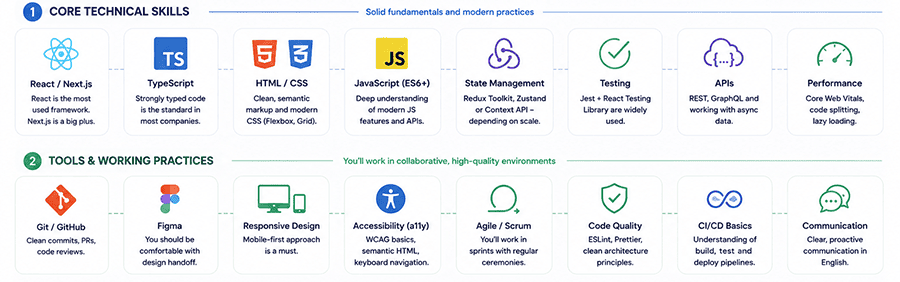
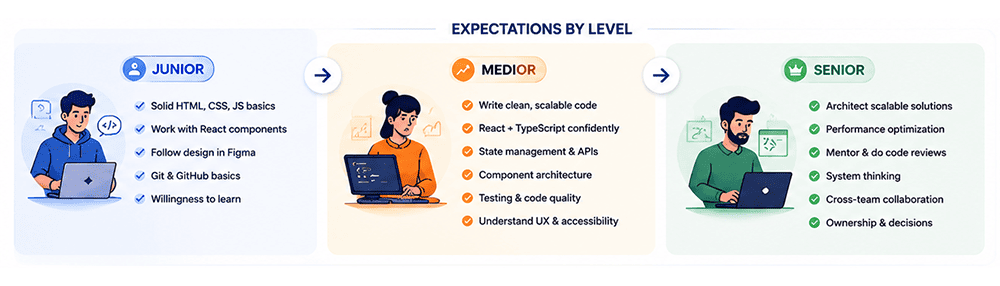
Based on analysis of active frontend postings across LinkedIn, Glassdoor, and devitjobs.nl, here's what appears consistently across seniority levels:
Non-negotiable across all levels:
- React or Angular - one of the two is required in over 80% of postings. Vue.js presence is growing but still a secondary market.
- TypeScript - mandatory in 65% of listings, strongly preferred in most of the rest. Submitting a portfolio without TypeScript in 2026 is a credibility gap.
- Git workflow literacy - branching strategies, pull request culture, meaningful commit messages. This comes up in interviews more than most developers expect.
- REST API integration - not building APIs, but consuming them confidently, handling edge cases, loading and error states.
- English at B2 minimum - written and spoken. Code reviews, sprint planning, stakeholder communication all happen in English.
- Agile/Scrum familiarity - not certification, just genuine experience working in sprints with a real team.
Expected at medior level and above:
- Testing - Jest, React Testing Library, Cypress or Playwright. The specific tool matters less than the habit. Companies that have been burned by untested codebases ask about this directly.
- Figma - reading design files, flagging implementation conflicts early, understanding spacing systems and component libraries. Pixel-perfect delivery is assumed, not praised.
- Performance awareness - Web Performance Optimization, lazy loading, bundle optimisation. Senior interviews at product companies almost always include a performance scenario.
- CI/CD basics - GitHub Actions or equivalent. Not DevOps depth, but enough to understand the pipeline your code moves through.
- Accessibility - WCAG familiarity is increasingly appearing in Dutch job descriptions, particularly at companies with large consumer audiences.
What separates candidates at senior level:
- Architecture decision-making - when to lift state, when to reach for a global store, when to split a component. The ability to articulate tradeoffs rather than just preferences.
- Design system experience - having built or meaningfully contributed to one, not just consumed it.
- Mentoring track record - Dutch senior roles almost universally include some expectation of supporting junior and medior colleagues.
- Cross-functional communication - working with product managers and designers as a peer, pushing back when requirements are technically unsound.
Building a Profile That Gets Responses
The Dutch recruiting market is LinkedIn-first. Most hiring managers and internal recruiters at Dutch tech companies source candidates directly through LinkedIn before postings go live publicly. Your profile is your first impression, and for international candidates it carries more weight than a CV.
Your headline. It should communicate stack, level, and intent in under ten words. "Frontend Developer | React & TypeScript | Open to Netherlands Roles" does more work than "Passionate Developer Looking for New Opportunities." Include the geography signal - Dutch recruiters filter by location and relocation intent, and making them guess costs you visibility.
Your About section. Write it in English. Three to four sentences: what you build, what you're good at, what you're looking for. Avoid objectives-statement language. Treat it as a senior engineer's summary of their own work, not a cover letter opener.
Your experience entries. Each role should include at least two to three sentences describing what the product actually did, what you owned technically, and one concrete outcome - performance improvement, user impact, architectural decision you drove. Dutch hiring managers read experience descriptions carefully. Bullet lists of technologies are not descriptions of work.
Open to Work settings. Set your location to Amsterdam, or use "Open to relocation" with Netherlands specified. Turn on the green "Open to Work" frame if you're comfortable with it - it increases recruiter outreach measurably, whatever the professional stigma in some markets.
Your Portfolio: What Dutch Companies Want to See
A GitHub profile with active commits and two to three deployed projects is standard expectation, not competitive advantage. What actually differentiates a portfolio in the Dutch market:
Documentation. A README that explains what the project does, why certain technical decisions were made, and how to run it locally signals exactly the kind of ownership mentality Dutch product companies hire for. It takes two hours to write and is read by more hiring managers than most developers assume.
Tests. Even basic unit and integration tests on a portfolio project communicate more about your professional habits than a list of testing tools on your CV. A project with no tests in 2026, at medior level or above, is a yellow flag.
Accessibility and performance. A Lighthouse score isn't a portfolio piece by itself, but a project that demonstrably handles keyboard navigation, has appropriate ARIA labels, and scores well on Core Web Vitals tells a story about craft that most portfolio projects don't.
Live deployment. Vercel, Netlify, or equivalent. Dutch companies don't download and run candidate projects locally. If there's no live link, the project effectively doesn't exist in most hiring pipelines.
Where to Actually Find the Openings
Different platforms serve different segments of the Dutch market, and using only one means missing significant portions of what's available:
- LinkedIn is the broadest source and the most competitive. Filter by location (Amsterdam, Rotterdam, Utrecht, Netherlands), job function (Engineering), and seniority level. Set up job alerts for "frontend developer," "React developer," and "frontend engineer" with Netherlands as the geography. Apply within the first 24-48 hours of a posting going live - Dutch recruiters often screen early applicants before the pool grows.
- Honeypot.io operates on a reverse model - you build a developer profile and companies apply to you. Response quality tends to be higher than inbound LinkedIn applications because the hiring intent is pre-qualified. Particularly strong for medior and senior profiles with React and TypeScript depth.
- devitjobs.nl is the closest thing to a Netherlands-specific tech job board and surfaces roles that don't always appear on international platforms, particularly from mid-size Dutch product companies and scale-ups.
- Talent.io functions similarly to Honeypot - developer-first, company-applies model. Strong coverage of Amsterdam fintech and scale-up companies.
- Direct company career pages. For the companies you've identified as genuine targets, check their careers page weekly. Roles at Booking.com, Adyen, and bol.com in particular often appear on their own sites before aggregators pick them up, and applying through the company portal rather than LinkedIn occasionally gets more direct routing to the hiring team.
The Dutch Interview Process: What to Expect
Understanding the typical hiring pipeline prevents the most common candidate mistakes - particularly the ones that come from treating Dutch interviews like interviews elsewhere.
Stage one: recruiter or HR screen. Usually thirty minutes, video call, conducted in English. Covers your background, motivation for the Netherlands specifically, visa situation if applicable, and salary expectations. Have a number ready - Dutch recruiters ask directly and expect a direct answer. Giving a range is fine; deflecting is not.
Stage two: technical assessment. This takes two forms depending on the company. Larger companies (Booking.com, Adyen, bol.com) tend toward take-home assignments: a realistic frontend task, typically three to five hours of work, evaluated for code quality, structure, and decision-making rather than just correctness. Smaller companies and startups more often run a live coding session - either on a shared IDE or through a platform like CoderPad. Prepare for both. For take-home assignments: write a brief README explaining your decisions, add at least basic tests, handle error states visibly. The assignment is evaluated as much on engineering judgment as implementation.
Stage three: technical interview. One or two engineers, sometimes including a tech lead or senior developer. Expect architecture questions - how would you structure a large React application, how do you manage state at scale, how do you approach performance optimisation. For senior roles, expect to defend decisions you've made in past work, not just abstract scenarios.
Stage four: culture or values interview. Dutch companies take this seriously. Questions tend toward real situations: describe a time you disagreed with a technical decision and how you handled it, how do you work with designers when requirements conflict with what's technically feasible, what does ownership mean to you in a development context. Prepare specific examples from your work history, not abstract answers.
Offer stage. Dutch companies typically move from final interview to written offer within one to two weeks. The offer letter will specify gross annual salary, holiday allowance (vakantiegeld - a legally required 8% annual holiday pay bonus), pension scheme, and any additional benefits. Review all of these, not just the base salary number.
Conclusion
The developers who do best in the Dutch job market share one characteristic: they treated the move as a considered decision rather than a fallback option. The Netherlands isn't the cheapest European market to enter, it isn't the easiest city to find housing in, and Amsterdam isn't going to hand you a senior role simply because you have five years of React experience. But for frontend developers who approach it with preparation, the combination of factors on offer here is genuinely difficult to replicate elsewhere in Europe.
Product companies that build at scale. An English-language working environment that doesn't require years of local language acquisition before you can function professionally. A government-backed tax incentive that structurally improves your financial position from month one. A visa route that, when your employer knows what they're doing, moves faster than almost anywhere else in the EU. And a job market where TypeScript, React, and a demonstrable sense of ownership over your work translate directly into strong compensation and genuine career progression. None of this is automatic. The 30% ruling requires an application that must be filed within a hard deadline. The Kennismigrant process depends on an employer who holds recognised sponsor status. The job market rewards developers who understand Dutch hiring culture - the expectation of directness, the emphasis on testing and documentation, the weight placed on cross-functional communication - over those who simply have the right keywords on their CV.
If you're seriously considering the Netherlands, the most useful next step isn't more research - it's updating your LinkedIn headline, deploying a portfolio project with a README, and sending five applications to companies from the list in this guide. The market is active. The roles are real. The 30% ruling clock starts on your first working day, which means the sooner you start, the sooner it starts working for you.
Frequently Asked Questions
Do I need to speak Dutch to work as a frontend developer in the Netherlands?
No - and this is one of the most persistent misconceptions about the Dutch job market. The overwhelming majority of tech companies in the Netherlands operate entirely in English: engineering standups, code reviews, product discussions, internal documentation, and company-wide communication all happen in English at international tech companies and most Dutch product companies of any meaningful scale. Dutch language skills improve your quality of life outside work and marginally expand your options at smaller, locally-oriented companies, but they are not a requirement for frontend roles at junior, medior, or senior level. Prioritising Dutch language learning before your job search is a reasonable long-term goal - making it a prerequisite before applying is not.
Can I apply for the 30% ruling if I'm an EU citizen?
Yes. The 30% ruling is not restricted to non-EU nationals. Any foreign specialist - regardless of passport - can qualify, provided they meet the residency history requirement: living outside the Netherlands for at least 16 of the 24 months immediately preceding their first Dutch working day. EU citizens who have been living and working in another EU country and relocate to the Netherlands for a job frequently qualify. The 150-kilometre rule is the most common disqualifier for EU applicants - if your previous address was within 150 kilometres of the Dutch border, the Belastingdienst may determine you weren't sufficiently "abroad."
How long does it realistically take to find a frontend job in the Netherlands from abroad?
For a medior or senior frontend developer with React and TypeScript experience, active applications, and a well-prepared profile, the realistic timeline is four to eight weeks from first application to verbal offer - based on hiring data from Dutch IT recruiters including Undutchables and Honeypot.io. The total time from starting your search to your first working day in the Netherlands, factoring in contract negotiation, Kennismigrant processing (if applicable), and physical relocation, is typically ten to sixteen weeks. Junior developers should allow more time - the market is more competitive at entry level and Dutch companies are selective about their first hires.
Is Amsterdam the only viable city for frontend developers, or are other cities worth considering?
Amsterdam concentrates the highest volume of roles and the highest compensation, but it is not the only viable option - and for some profiles it isn't the best one. Rotterdam has a growing tech scene with meaningfully lower rental costs and strong demand in logistics tech, fintech, and e-commerce. Utrecht offers excellent quality of life, lower housing costs than Amsterdam, and direct rail access to both Amsterdam and Rotterdam - bol.com alone runs a substantial frontend engineering operation there. Eindhoven is the right choice for developers interested in enterprise-scale engineering at ASML or Philips Tech, with a deep Angular and TypeScript culture. The practical question is less "which city" and more "which companies" - and those companies are distributed across all four.
What happens to the 30% ruling if I change jobs?
The ruling doesn't disappear when you change employers, but it doesn't automatically transfer either. When you move to a new Dutch employer within your five-year window, you must submit a new application with that employer. The combined duration of all applications cannot exceed the original five-year maximum - the clock doesn't reset. There is a gap tolerance: if there is a break of three months or less between employment contracts, continuity is generally maintained. A gap longer than three months may require demonstrating you still meet the original residency conditions, which is more complex. If you're planning a job change, coordinate the 30% ruling application with your new employer before your start date, not after.
Can freelancers and contractors access the 30% ruling in the Netherlands?
Not through the standard route. The 30% ruling requires an employment relationship with a Dutch employer - a payroll contract, not a freelance or contractor arrangement. Independent contractors registered as a sole trader (eenmanszaak) or through a limited company (BV) cannot apply for the ruling on their own self-employment income. Some developers structure their engagement through a Dutch umbrella company (payroll BV) specifically to access the ruling, but this is a complex arrangement that requires specialist tax advice and isn't universally accepted by the Belastingdienst. If contracting is your preferred working model and the 30% ruling is financially important to you, a consultation with a Dutch tax adviser before structuring your engagement is not optional - it's the starting point.
What is vakantiegeld and does it affect my salary calculation?
Vakantiegeld - literally "holiday money" - is a legally mandated annual bonus of 8% of your gross annual salary, paid in May in the Netherlands. It is not discretionary and not company-specific: every Dutch employer is required by law to pay it. In practical terms, if your contract states €70,000 gross annual salary, your total annual compensation including vakantiegeld is €75,600.
When evaluating and comparing offers, always check whether the stated salary is inclusive or exclusive of vakantiegeld - some companies quote the all-in figure, others quote base only. Dutch job postings increasingly specify this, but when in doubt, ask directly during the offer stage.
How does remote work factor into the Dutch frontend job market in 2026?
The Dutch market has settled into a hybrid norm rather than the full-remote flexibility that briefly became standard during 2020-2022. Most Dutch tech companies in 2026 expect two to three days per week in the office, with some flexibility depending on seniority and role. Full-remote arrangements for candidates based outside the Netherlands are offered selectively - primarily at companies with established distributed team infrastructure or for senior profiles where the talent pool justifies the operational complexity. If remote work is a firm requirement for you, filter for it explicitly in your search rather than assuming flexibility during negotiation. Companies that genuinely operate remotely say so clearly in their job descriptions; those that don't often present hybrid arrangements as more flexible than they prove to be in practice.