

Svelte vs React vs Vue vs Angular: Which Framework Should You Learn?
11 June 2026
242 views
This article is up to date as of August 2026

Written by
Daniel Carter,
Principal Frontend Engineer

Reviewed by
Lena Morrison,
Lead React Engineer
Picking your first frontend framework in 2026 feels a lot like choosing a phone plan - every option looks reasonable until you actually start comparing them. React has been dominating job boards for years and still holds the largest share of the market. Vue is praised for being beginner-friendly and elegant. Angular is the go-to choice for enterprise teams that need structure and predictability. And Svelte keeps quietly gaining ground, winning over developers who are tired of boilerplate and want something that just feels lighter. With so many solid options on the table, it's no wonder that "react vs vue vs angular comparison" threads still flood developer forums every single week.
The framework you choose in 2026 will shape more than just your first project. It influences which job listings you qualify for, how fast you build real skills, and how easily you can switch stacks later.
These frameworks aren't just different tools; they represent different philosophies about how UIs should be built, maintained, and scaled. Understanding those react vs vue vs angular differences at a deeper level is what separates developers who make a confident choice from those who switch frameworks every three months chasing something better.
Svelte vs React vs Vue vs Angular at a Glance
Before diving into specifics, it helps to understand what each of these frameworks actually is - and more importantly, what kind of developer it was built for. React is a UI library from Meta that gives you maximum flexibility but also puts more decisions on your plate. Vue is a progressive framework designed to be incrementally adoptable, which is a fancy way of saying you can start small and scale up without rewriting everything. Angular is a full-blown opinionated framework from Google with a steep learning curve that pays off in large, complex applications. Svelte takes a completely different approach - instead of shipping a runtime to the browser, it compiles your components into plain JavaScript at build time, which results in faster load times and less code overall.
When you line up Svelte vs React vs Vue vs Sngular side by side, the differences go beyond syntax. Each framework reflects a distinct set of priorities: React values flexibility and ecosystem size, Vue values developer experience and approachability, Angular values consistency and enterprise-grade tooling, and Svelte values performance and simplicity above everything else. None of them is objectively better - but for any given developer at any given stage of their career, one of them is almost certainly a better fit than the others. The table below makes those differences concrete.
Svelte vs React vs Vue vs Angular: Side-by-Side Comparison
| Criteria | React | Vue | Angular | Svelte |
| Type | UI Library | Progressive Framework | Full Framework | Compiler |
| Created by | Meta | Evan You | Rich Harris | |
| Initial release | 2013 | 2014 | 2016 (v2) | 2016 |
| Language | JSX + JS/TS | HTML templates + JS/TS | TypeScript (required) | HTML + JS/TS |
| Learning curve | Medium | Low-Medium | High | Low |
| Performance | Good | Good | Good | Excellent |
| Bundle size | Medium | Small-Medium | Large | Very small |
| Job market demand | Very High | Medium | High | Low |
| Best for | SPAs, startups, large apps | Beginners, mid-size apps | Enterprise, large teams | Performance-focused apps |
| State management | Context, Redux, Zustand | Pinia, Vuex | NgRx, built-in services | Built-in stores |
| Community size | Largest | Large | Large | Growing |
Which Framework Is Easier to Learn?
Learning curve is probably the most personal factor in this entire comparison, because it depends heavily on what you already know and how you learn best. A developer coming from a strong vanilla JavaScript background will find React's mental model relatively natural, while someone who started with PHP templates might feel more at home with Vue's structure from day one. What the data and collective developer experience do agree on is a rough order: Svelte and Vue tend to click faster for most beginners, React sits in the middle, and Angular requires the most upfront investment before things start making sense.
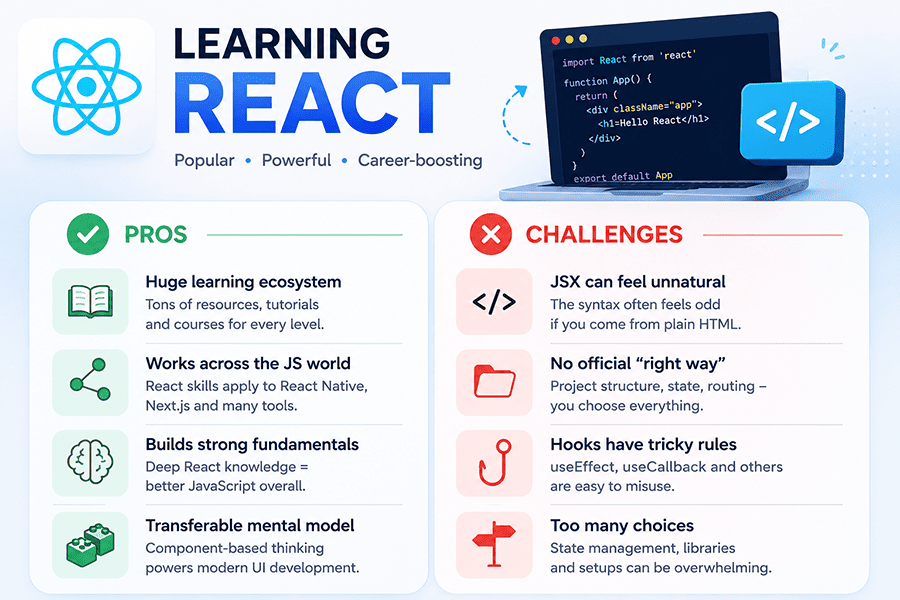
Learning React
Pros:
- Enormous amount of learning resources, tutorials, and courses available at every skill level
- Skills transfer directly to React Native, Next.js, and a large portion of the broader JS ecosystem
- Understanding React deeply builds strong JavaScript fundamentals that benefit you regardless of where your career goes
- Component-based thinking is a highly transferable mental model across modern frontend development
Challenges:
- JSX syntax feels awkward and counterintuitive for many beginners coming from standard HTML
- No official conventions for project structure, state management, or routing - you have to make a lot of decisions yourself
- Hooks like useEffect and useCallback have subtle rules that trip up beginners and even intermediate developers regularly
- The sheer volume of available options (Redux vs Zustand vs Jotai vs Context...) creates decision fatigue early on
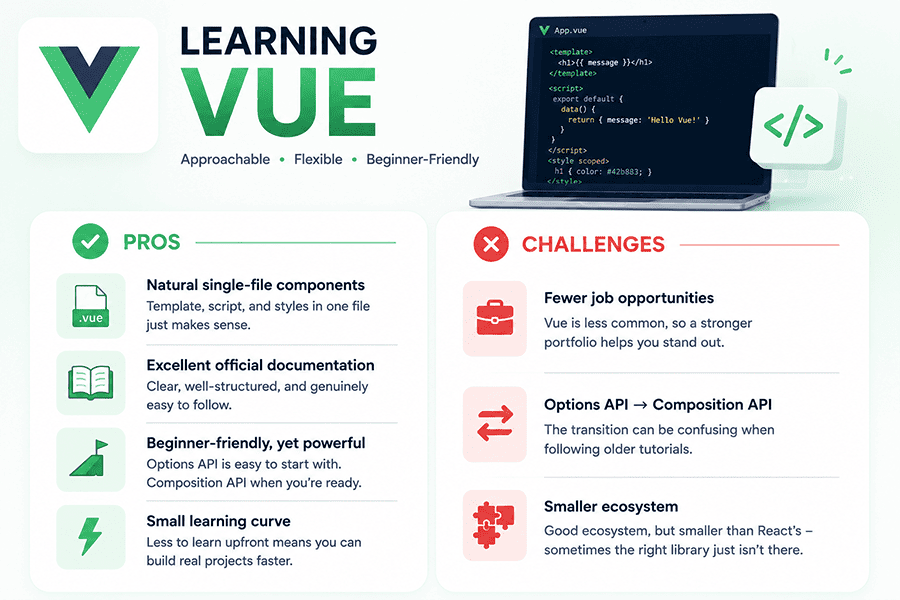
Learning Vue
Pros:
- Single-file components with clear separation of template, script, and styles feel natural for developers with HTML/CSS experience
- Official documentation is exceptionally clear, well-organized, and beginner-friendly
- The Options API provides a gentle on-ramp for beginners, with the Composition API available when you're ready for more power
- Smaller surface area means less to learn before you can build something real
Challenges:
- Fewer job opportunities means you may need a stronger portfolio to compensate for a less common framework choice
- The shift from Options API to Composition API creates some confusion when following older tutorials
- Vue's ecosystem, while solid, is smaller than React's - you'll occasionally hit a use case where the best library just doesn't exist yet
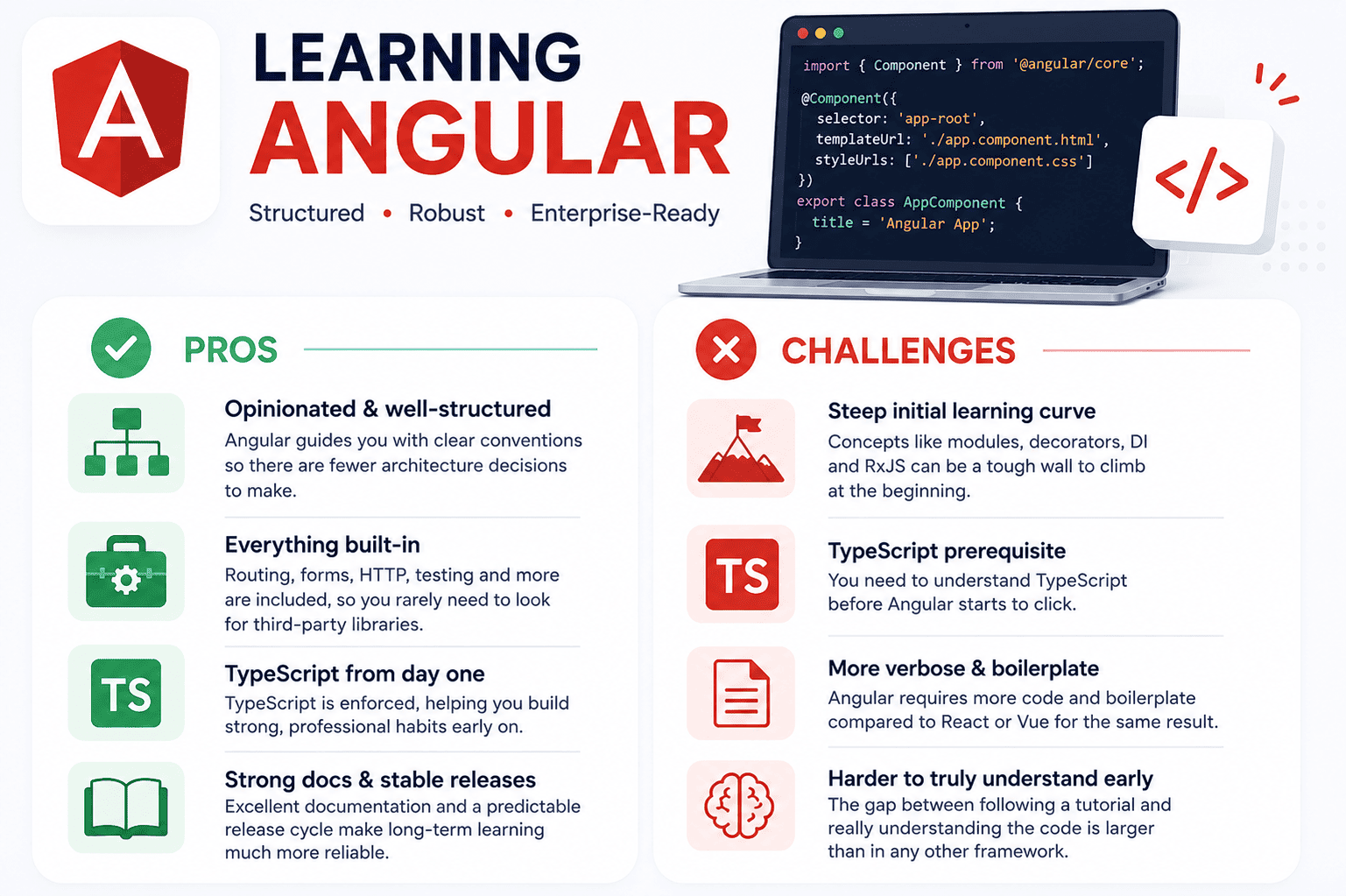
Learning Angular
Pros:
- Opinionated structure means fewer architectural decisions to make - the framework tells you how things should be organized
- Built-in solutions for routing, forms, HTTP, and testing mean you rarely need to evaluate third-party libraries
- TypeScript is enforced from the start, which builds habits that are genuinely valuable in professional environments
- Strong documentation and a stable, predictable release cycle make long-term learning feel less like chasing a moving target
Challenges:
- The initial concepts - modules, decorators, dependency injection, RxJS - represent a steep and sometimes discouraging learning wall
- You need to understand TypeScript before Angular starts making sense, which adds a prerequisite most other frameworks don't require
- Angular's verbosity means writing significantly more boilerplate code than you would in React or Vue for the same result
- The gap between "following a tutorial" and "understanding what you actually wrote" is wider in Angular than in any other framework here
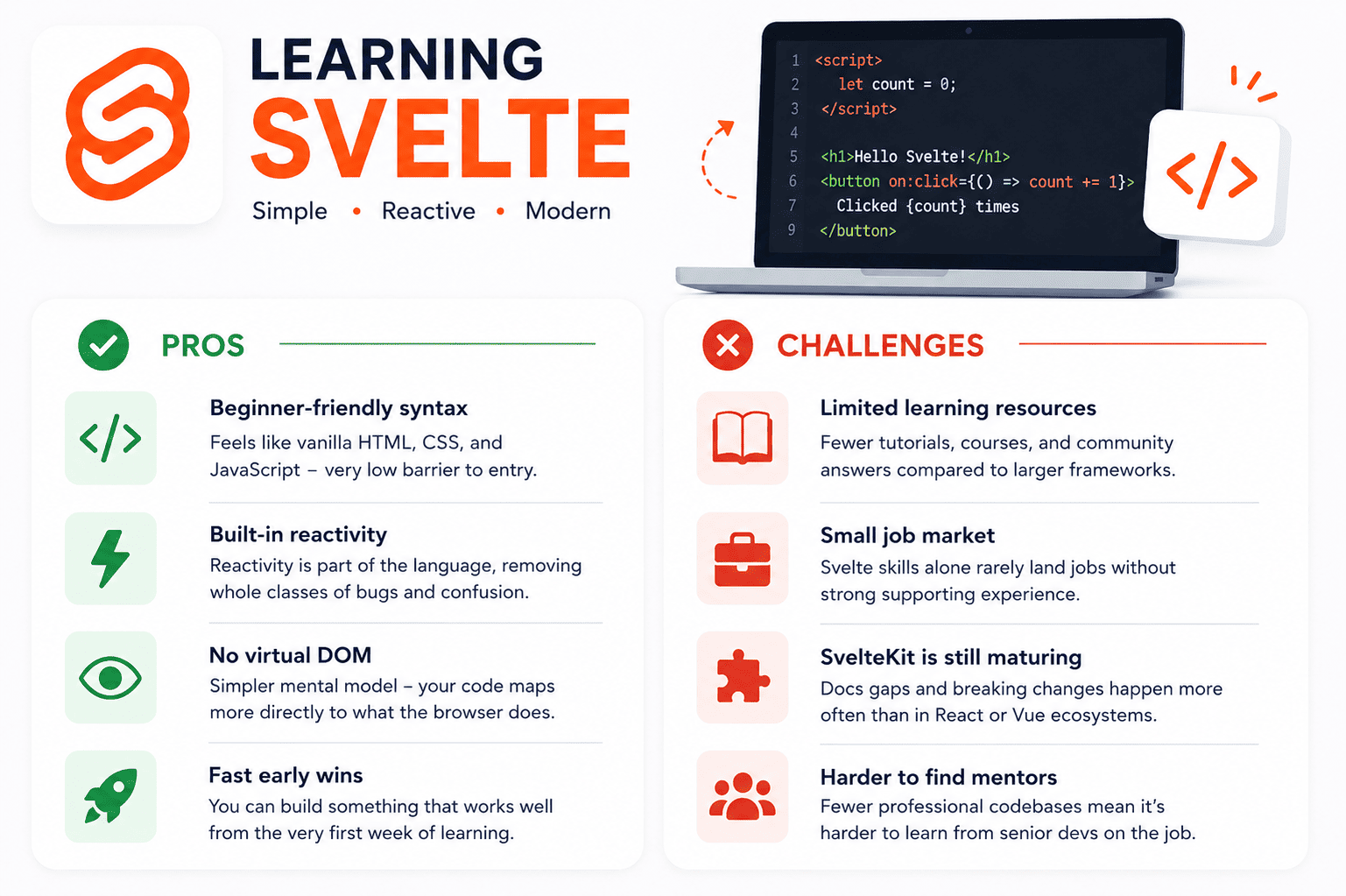
Learning Svelte
Pros:
- The syntax is the closest to plain HTML, CSS, and JavaScript of any framework on this list - the barrier to entry is genuinely low
- Reactivity is built into the language itself, which eliminates a whole category of bugs and confusion that React developers regularly encounter
- No virtual DOM means the mental model is simpler - what you write maps more directly to what the browser does
- Building something that works well from the very first week of learning is a realistic expectation with Svelte
Challenges:
- Significantly fewer learning resources, courses, and community answers compared to React, Vue, or Angular
- Small job market means that Svelte proficiency alone is unlikely to land you a job without strong supporting skills
- SvelteKit, the full-stack companion framework, is still maturing - documentation gaps and breaking changes are more common than in the equivalent React or Vue ecosystems
- Because so few professional codebases use Svelte, it's harder to find mentors or senior developers to learn from on the job
How long does it take to learn Frontend Frameworks
| Framework | Time to Basics (productive) | Time to Proficiency | Time to Advanced | Key Learning Challenges |
| Svelte | 1-2 weeks | 3-4 weeks | 6-8 weeks (with SvelteKit) | Compiler mindset, SvelteKit SSR/routing |
| Vue | 2-4 weeks | 2-3 weeks | 2-4 months | Composition API, reactivity system |
| React | 3-5 weeks | 3-6 weeks | 6-12 months | Hooks, JSX, state management ecosystem, Next.js |
| Angular | 3-5 weeks | 3-4 months | 6-12 months | TypeScript, RxJS, dependency injection, modules |
Svelte vs React vs Vue vs Angular Job Market in 2026
The frontend job market in 2026 looks different from what it did three or four years ago, but one thing hasn't changed: React is still the dominant force. What has shifted is the context around it. The explosion of AI-assisted development tools, the rise of full-stack frameworks like Next.js and Nuxt, and the gradual consolidation of mid-size companies around fewer, more stable tech choices have all reshaped how employers think about frontend hiring.
Developers who expected Angular to fade out by now were wrong - enterprise demand kept it firmly relevant. And Vue, while never quite breaking into the top tier of US job market demand, has held its ground in European and Asian markets where it built a loyal following years ago. What's worth paying attention to in 2026 is the shift toward full-stack expectations in frontend roles.
A job posting that says "React developer" in the title often means the company also expects you to know Next.js, have a working understanding of REST APIs, and be comfortable with at least basic TypeScript. The same pattern applies to Angular roles, where TypeScript has been mandatory for years and RxJS knowledge is frequently listed as a requirement rather than a nice-to-have. This means the raw number of job postings tied to a specific framework doesn't tell the whole story - what matters is the full skill set that each framework ecosystem tends to pull along with it, and how well that matches where the industry is heading.
Most companies using Svelte are either startups experimenting with newer technology or development shops that specifically prioritize performance and lean bundles. That's a real niche, but it's still a niche. Developers who choose Svelte as their primary framework should go in with open eyes - it's a fantastic tool that will likely grow, but in 2026 it isn't yet the kind of skill you can rely on to generate a steady stream of inbound recruiter messages the way React does.
Which Framework Has the Most Jobs?
React has the most jobs - and it's not particularly close. Across major English-language job platforms, React consistently accounts for somewhere between 50 and 60 percent of frontend framework-specific listings, with Angular typically coming in second at around 25 to 30 percent, Vue holding a smaller but stable share, and Svelte in the low single digits. These numbers shift depending on how you search and which platform you use, but the relative order has been remarkably consistent for several years now.
Angular's second-place position often surprises developers who assume it's becoming obsolete. The reality is that Angular's strict conventions and enterprise-friendly architecture make it the default choice for a specific type of company - one that prioritizes long-term maintainability over developer flexibility. Banks, insurance companies, large SaaS platforms, and government-facing software teams frequently land on Angular precisely because its opinionated structure makes large codebases easier to manage.
Vue occupies a tricky middle ground in the job market conversation. It has enough of a presence to be a viable path to employment, particularly in certain geographies and industries, but it doesn't offer the same volume of opportunities as React. The practical implication for someone choosing Vue as their primary framework is that job searching may take longer and may require being more strategic - targeting companies that have publicly mentioned Vue in their stack, reaching out to smaller agencies, or building a strong enough portfolio that employers are willing to overlook a less common framework choice.
| Framework | Job Market in 2026 | Main Reason | Best For |
| React | Highest number of jobs | Largest ecosystem, broad adoption across startups and enterprises, and strong ongoing demand | Maximum job opportunities |
| Angular | Medium to high, especially in enterprise | Common in large corporate, banking, healthcare, and government systems | Enterprise roles and long-term stability |
| Vue | Moderate | Popular in some regions and companies, but fewer listings than React overall | Simpler learning curve and regional demand |
| Svelte | Lowest among the four | Smaller ecosystem and fewer job openings compared with the others | Personal projects and lightweight apps |
If your goal is getting hired faster, React is the safest choice in 2026 because it appears to have the widest job market and the most listings across sources. Angular can be a strong second option if you want enterprise work, while Vue and Svelte are better when you prefer simplicity or specific ecosystem fits.
Frontend Frameworks Salaries Compared
The most consistent pattern in compensation data is that Angular developers tend to report slightly higher average salaries than their React and Vue counterparts - but this almost certainly reflects the types of companies that hire Angular developers rather than anything special about Angular itself. Enterprise environments, financial institutions, and large consultancies pay well across the board, and they happen to prefer Angular. React developers have the highest volume of high-paying opportunities simply because the sheer number of React roles includes a healthy proportion of well-funded startups and top-tier tech companies. Vue salaries cluster in the middle, and Svelte data is still too sparse to draw reliable conclusions from.
What the salary conversation really comes down to is this: no framework will make you highly paid on its own. But choosing a framework with strong job market demand - and pairing it with TypeScript, testing knowledge, and at least one full-stack tool like Next.js or Nuxt - puts you in a significantly stronger negotiating position than framework knowledge alone ever could.
Here is a table comparing average salaries for frontend developers by framework in 2026 (US data, annual):
| Framework | Average Annual Salary (US, 2026) | Salary Range (typical) | Notes |
| Svelte | $109,905 - $140,143 | $84,000 (25th %ile) to $150,500 (90th %ile) | Highest average at startups (~$140k), but fewer total jobs |
| React | $129,348 - $142,566 | $106,000 (25th %ile) to $157,000 (75th %ile) | Most in-demand, highest job volume; Web3 React avg ~$150k |
| Angular | $121,649 - $141,406 | $33,600 to $267,840 (wide range) | Strong enterprise demand; high ceiling in senior/enterprise roles |
| Vue | $110,412 - $122,903 | ~$113,985 to $129,525 | Slightly lower than React/Angular; smaller job market |
In the US (2026), React and Angular developers earn the highest typical salaries, with React having the most jobs and Angular having strong enterprise pay. Svelte can pay very well at startups, but has far fewer openings. Vue salaries are slightly lower on average due to smaller demand.
Common Mistakes When Choosing a Frontend Framework
Choosing a frontend framework should be a practical decision based on your goals, your local job market, and your current skill level. In reality, most beginners make this choice based on something they saw on YouTube, a Reddit comment from someone with strong opinions, or the vague feeling that one framework sounds more impressive than another. Understanding the most common mistakes developers make at this stage doesn't just help you choose better - it helps you learn faster and stick with the path long enough to actually see results.
My Recommendation for Most Beginners in 2026
If you're at the beginning of your frontend journey and you're reading this looking for someone to just tell you what to do - here it is: start with React.
Not because React is the most elegant framework. Not because its syntax is the friendliest or its learning curve the gentlest. But because in 2026, React gives you the best combination of learning resources, job market demand, ecosystem depth, and long-term career flexibility of anything available. When you compare svelte vs react vs vue vs angular through the lens of what actually matters for someone starting from scratch - getting employed, building real skills, and having a clear path forward - React comes out ahead for the majority of people in the majority of situations.
Vue is a genuinely excellent alternative if you find React's initial complexity discouraging or if your target job market has stronger Vue adoption. There is no wrong answer between those two. Angular makes sense if you have a specific enterprise target in mind and are willing to front-load the learning investment. Svelte is worth your time once you have a first framework under your belt and want to expand your range.
Every framework on this list has produced employed, skilled, well-paid developers. The variable that matters most isn't which tool you pick - it's how seriously you commit to getting good at it.
Questions Developers Actually Ask Before Choosing a Framework
Is React still worth learning in 2026 despite increasing competition from newer frameworks?
Yes - and the case for React hasn't weakened as much as the noise around newer frameworks might suggest. The argument against learning React usually goes something like this: it's old, it's verbose, and more modern alternatives like Svelte do the same job with less code and better performance. That argument isn't wrong on the technical merits, but it misses the point of why React remains worth learning. React's value in 2026 isn't just the library itself - it's the ecosystem built around it. Next.js has become one of the most sought-after full-stack skills in the industry.
React Native remains the dominant cross-platform mobile framework. Vercel, one of the most influential companies in modern web infrastructure, has built its entire product strategy around React. The number of production codebases running React globally means that React developers will be in demand for years regardless of what the next popular framework turns out to be. Learning React also teaches you patterns - component architecture, unidirectional data flow, declarative UI thinking - that transfer directly to every other modern framework. The competition is real, but React's lead is structural, not just popular, and that kind of lead takes a long time to erode.
Can I realistically get a frontend developer job in 2026 by learning only Vue and skipping React entirely?
Yes, it's realistic - but it requires a more deliberate approach than the same path would with React. Vue's job market is genuine and stable, but thinner than React's in most English-speaking markets, which means your job search will likely take longer and require more targeted effort. The developers who succeed with this path typically do a few things right: they build a portfolio that demonstrates real-world Vue proficiency rather than tutorial reproductions, they learn the full Vue ecosystem including Nuxt and Pinia rather than stopping at the basics, and they research their local or target job market carefully before committing. In markets where Vue has strong adoption - parts of Europe, Southeast Asia, and companies with PHP or Laravel backgrounds who gravitated toward Vue early - this path is genuinely competitive. In markets dominated by US-style tech startups and scale-ups, it's harder. The honest answer is that Vue-only is a viable strategy with the right targeting, but React-first gives you more room for error, which matters when you're just starting out and can't yet afford to be picky about which roles you apply to.
Why do large companies and enterprises continue using Angular in 2026 when newer alternatives exist?
The answer comes down to switching costs, organizational structure, and what large engineering teams actually need from a framework. When a company has a codebase that's been in production for five or six years, employs fifty frontend developers, and needs to onboard new team members every quarter, the calculus around framework choice looks completely different from what an individual developer considers when picking something to learn. Angular's enforced TypeScript, strict project structure, and opinionated conventions mean that code written by a developer who joined last month looks structurally similar to code written by someone who left two years ago.
That consistency has real monetary value in large organizations where developer turnover is a constant reality. Angular also comes with everything included - routing, forms, HTTP client, testing utilities - which matters to enterprise teams that can't afford to spend engineering time evaluating and maintaining a collection of third-party libraries. Add to that the fact that Google actively maintains Angular with a clear long-term roadmap, and you have a framework that enterprise risk management teams can point to as a stable, supported investment. Rewriting a large Angular codebase in React or Vue would cost more than most companies are willing to spend for a marginal improvement in developer experience.
How long does it realistically take to become job-ready with React, Vue, or Angular if I study consistently every day?
The honest answer varies more than most learning roadmaps admit, but there are useful reference points based on consistent daily practice of two to three hours. With React, most developers reach a point where they can handle entry-level job requirements - building component-based UIs, managing state, consuming APIs, working with React Router and basic hooks - somewhere between four and six months, assuming solid JavaScript fundamentals going in. Without those fundamentals, add another two months minimum. Vue tends to move faster: three to five months to a similar level of job readiness, largely because the framework introduces fewer novel concepts and the documentation is clearer for beginners. Angular is the outlier - six to nine months is a realistic estimate for reaching genuine job-ready proficiency, accounting for the time needed to get comfortable with TypeScript, decorators, RxJS, and Angular's module system before the pieces start connecting. These timelines assume you're building real projects alongside structured learning, not just watching tutorials. The gap between "finished a course" and "can actually build and debug a real application" is where most self-taught developers get stuck, and closing that gap requires project work that goes beyond what any course assigns.
Will AI tools and code generation replace the need to learn frontend frameworks like React, Vue, or Angular in the next few years?
AI tools have already changed how frontend developers work - but they haven't changed what you need to understand to work effectively. The developers getting the most value from AI code generation tools in 2026 are the ones who understand the frameworks well enough to evaluate, modify, and debug the code those tools produce. An AI assistant can scaffold a React component in seconds, but if you don't understand what useEffect is doing or why a state update isn't triggering a re-render, you're stuck the moment the generated code doesn't behave as expected - which happens constantly in real projects.
The more likely scenario over the next few years isn't that AI replaces the need to learn frameworks, but that it raises the floor of what junior developers can produce while simultaneously raising employer expectations. Developers who understand frameworks deeply will use AI to move faster. Developers who relied on AI to avoid learning frameworks deeply will hit walls that no prompt can get them past. Learning a framework properly in 2026 is still the investment it always was - AI just changes the tools available during that learning process, not the underlying need for genuine understanding.
Should I learn TypeScript before starting to learn React, Vue, or Angular - or can I learn them at the same time?
The answer differs meaningfully depending on which framework you're learning. For Angular, TypeScript is not optional - it's baked into the framework at a fundamental level, and trying to learn Angular without TypeScript is like trying to learn to drive in a car you don't understand. You need to at least cover TypeScript basics before your first Angular tutorial makes sense. For React and Vue, the situation is more flexible. Both frameworks work fine with plain JavaScript, and learning them in JavaScript first is a completely valid approach - it lets you focus on framework concepts without simultaneously absorbing a new type system. That said, TypeScript has become the professional standard in both ecosystems, and most job postings list it as expected rather than optional.
A practical middle path for React or Vue learners is to spend the first two to three months learning the framework in JavaScript, then layer in TypeScript once the core concepts feel solid. Trying to absorb both at once from day one tends to create confusion about which errors are TypeScript complaints and which are framework misunderstandings - a distinction that's hard to make when both are new.
Which frontend framework has the best long-term future and is least likely to become obsolete after 2026?
React is the safest long-term bet based on structural factors rather than just current popularity. Meta's continued investment, the Next.js ecosystem's momentum, React's deep integration into enterprise codebases worldwide, and the sheer number of developers who know it create a kind of inertia that's genuinely hard to displace. Even if a technically superior framework captures developer mindshare over the next few years, React's installed base means demand for React developers will remain strong for a long time after that shift begins. Angular's future is similarly secure in its specific context - enterprise demand doesn't evaporate quickly, and Google's backing provides institutional stability.
Vue's future depends more heavily on community momentum and continued Evan You involvement, but Vue 3 and the Vite ecosystem have put the framework on a solid technical foundation that should sustain it well past 2026. Svelte is the wildcard - technically impressive, growing steadily, and with SvelteKit providing a compelling full-stack story, but still dependent on crossing a threshold of enterprise adoption that hasn't happened yet. The realistic answer is that all four frameworks will still exist and be used professionally five years from now. The question isn't which one survives - it's which one keeps generating the kind of job market demand that makes your skills feel secure.
Others Also Read