

Best Frontend Developer Roadmap in 2026
08 April 2026
357 views
This article is up to date as of August 2026

Written by
Daniel Carter,
Principal Frontend Engineer

Reviewed by
Miles Bennett,
Senior Frontend Architect
Frontend development in 2026 is no longer limited to HTML, CSS, and a single JavaScript framework. The role has expanded into performance engineering, component architecture, accessibility, design systems, API integration, mobile interfaces, and AI-assisted workflows. Because of this rapid growth, many developers feel overwhelmed by the number of technologies they should learn and the order in which they should learn them. That is exactly why having the best roadmap for Frontend developer growth is more important than ever. A structured roadmap removes guesswork and gives developers a clear progression path from fundamentals to production-level architecture.
The strongest frontend learning path today starts with solid web foundations, then gradually moves into framework specialization, tooling, scalable state management, and advanced frontend architecture. A beginner needs very different milestones than a middle or senior engineer, so the roadmap should reflect real career progression rather than a random list of technologies. In 2026, the most effective frontend engineers combine strong browser fundamentals with modern frameworks like React, Vue, Angular, and Next.js, while also understanding TypeScript, Git workflows, performance optimization, and cross-platform development.
What Is Web Frontend Roadmap?
A web frontend roadmap is a structured learning path that helps developers understand what to study, in what sequence, and why each stage matters for real projects. Instead of jumping randomly between frameworks, tutorials, and trends, a roadmap provides a logical progression from browser fundamentals to advanced engineering topics. A strong Frontend dev roadmap usually begins with HTML, CSS, JavaScript, Git, and responsive design, then expands into frameworks, TypeScript, performance optimization, testing, and frontend architecture.
The reason this structure matters is simple: frontend development is highly layered. Without strong fundamentals, frameworks become difficult to understand deeply. Without Git and tooling, collaboration becomes inefficient. Without architecture and performance knowledge, developers often hit a career ceiling at the middle level. A frontend developer roadmap solves this by turning the learning process into clear milestones. It also helps developers identify what skills belong to junior, middle, and senior levels, making career progression more measurable and realistic.
The best roadmap is not just about learning technologies. It should also guide developers toward real project work, reusable component thinking, debugging habits, and problem-solving skills that match real product teams.
Visual Guide Before You Start the Journey
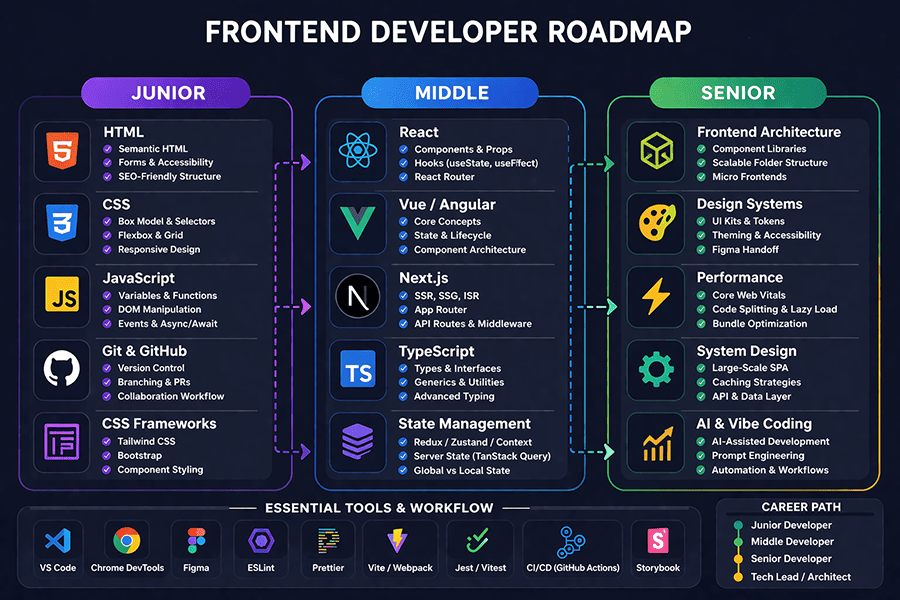
To make this learning path easier to understand, the next section includes a Frontend developer roadmap infographic that visually maps the progression from fundamentals to advanced frontend engineering. This visual flow helps you quickly identify where you are today, what comes next, and which roadmap branches are most relevant to your current level. It is especially useful for developers who prefer structured, visual planning before diving into detailed roadmap sections.
Junior Frontend Roadmap: The Smartest Start for 2026
The junior Frontend roadmap in 2026 should focus on building deep confidence in browser fundamentals before moving into frameworks. One of the biggest mistakes beginners make is jumping directly into React or Next.js without fully understanding how the browser renders pages, how CSS layouts behave, or how JavaScript controls interactivity. A strong junior path must first teach how websites are structured, styled, and made interactive. This creates the mental model required to understand more advanced frameworks later.
A good roadmap Frontend junior path should also introduce development habits early: version control, debugging, clean file organization, responsive thinking, and reusable UI patterns. At this stage, the goal is not specialization but reliability. A junior developer should be able to build responsive landing pages, simple multi-section websites, forms, navigation menus, API-based widgets, and reusable components using plain JavaScript before moving into framework-heavy ecosystems. Once the fundamentals become second nature, transitioning into React, Vue, Angular, or TypeScript becomes dramatically easier.
Below are the most important beginner-friendly roadmaps to master first:
-
Frontend Web Fundamentals Roadmap
Covers how the browser works, page structure, semantic markup, responsive layout basics, forms, accessibility foundations, and simple UI logic. This roadmap builds the technical base every frontend developer needs. -
HTML Roadmap
Focuses on semantic tags, forms, accessibility-friendly markup, SEO-safe structure, tables, media embedding, and content hierarchy. Essential for building clean and maintainable page structures. -
CSS Roadmap
Includes selectors, box model, positioning, Flexbox, Grid, responsive design, animations, transitions, and maintainable styling practices used in production UI development. -
JavaScript Essentials Roadmap
Teaches variables, functions, DOM manipulation, events, arrays, objects, modules, async basics, and UI interactivity. This is the roadmap that transforms static pages into real applications. -
Git & GitHub Roadmap
Covers version control, branching, commits, pull requests, conflict resolution, and collaboration workflows required in real development teams. -
CSS Frameworks Roadmap
Introduces Tailwind CSS, Bootstrap, and component-based styling workflows that help juniors build interfaces faster while learning design consistency.
Middle Frontend Developer Roadmap: From Features to Scalable Systems
The middle Frontend developer roadmap is where a developer transitions from simply building features to designing maintainable application structures. At this stage, the focus shifts from browser fundamentals to framework mastery, typed codebases, scalable state management, routing, API orchestration, testing, and performance-aware component design. Middle-level engineers are expected not only to implement screens, but to think about how those screens evolve as products grow. This means understanding reusable architecture, clean data flow, modular UI systems, and predictable development workflows.
A strong middle Frontend developer roadmap should help engineers become confident with at least one major framework ecosystem while also expanding into production-ready tooling. This is the phase where developers stop thinking page-by-page and start thinking in systems: shared layouts, route boundaries, feature modules, reusable hooks, component libraries, typed APIs, and maintainable state layers. It is also the best moment to strengthen collaboration skills through Git workflows, code reviews, testing strategies, and design-to-development communication. By the end of this level, a developer should be able to independently build complex dashboards, authenticated apps, CMS-driven websites, SaaS interfaces, and mobile-ready UI systems.
Below are the most important roadmap paths for growing from junior into confident middle-level frontend roles:
-
React Developer Roadmap
Covers component architecture, hooks, routing, state patterns, reusable logic, performance optimization, and testing. Best for modern product companies and SaaS applications. -
Vue.js Developer Roadmap
Focuses on Vue components, Composition API, Pinia, routing, and scalable UI workflows. Great for teams that prioritize simplicity and structured maintainability. -
Angular Developer Roadmap
Includes TypeScript-heavy architecture, modules, dependency injection, RxJS, enterprise routing, and scalable large-team patterns. -
Next.js Roadmap
Covers SSR, SSG, routing, layouts, API routes, performance optimization, SEO, and full-stack frontend workflows. -
TypeScript Roadmap
Essential for safer large-scale codebases, typed APIs, reusable interfaces, and maintainable collaboration in growing teams. - React Native Roadmap Helps frontend developers extend their skills into mobile apps using React concepts, shared component logic, and native UI workflows.
Senior Frontend Roadmap: Architecture, Leadership, and Product-Scale Engineering
The senior Frontend roadmap is the stage where frontend development becomes much bigger than frameworks and UI implementation. At this level, engineers are expected to design systems that multiple teams can safely build on, define architectural standards, improve performance at scale, and make long-term technical decisions that influence the product roadmap. A senior frontend engineer should understand rendering pipelines, bundle strategy, design systems, observability, accessibility governance, and how frontend choices affect product velocity. The role evolves from “building features” into “building systems that make features easy to ship.”
A mature Senior Frontend roadmap should focus on architecture depth, cross-team scalability, and future-proof engineering decisions. This includes frontend system design, micro-frontend strategies where appropriate, advanced performance optimization, state boundaries across domains, testing governance, CI quality gates, and shared component ecosystems. Senior developers also need leadership capabilities: mentoring, code review standards, roadmap planning, technical debt prioritization, and collaboration with product, design, and backend architecture teams. In 2026, this level increasingly includes AI-assisted engineering workflows, design-to-code pipelines, and experimental productivity layers that help teams move faster without sacrificing code quality.
The most valuable roadmap paths at this level include:
-
Advanced Frontend Roadmap
Covers frontend architecture, rendering performance, caching strategies, testing systems, design systems, observability, and large-scale UI governance. This is the core roadmap for senior engineering growth. -
Next.js Roadmap
At the senior level, this roadmap becomes more about architecture decisions: SSR boundaries, edge rendering, caching, SEO strategy, and platform scalability. -
TypeScript Roadmap
Focuses on advanced typing patterns, shared contracts, SDK design, API schemas, and enforcing safer multi-team codebases. -
React Developer Roadmap / Vue.js / Angular
Senior engineers go beyond framework syntax and focus on scaling patterns, module boundaries, performance profiling, and shared abstractions. -
Vibe Coding
Introduces AI-assisted UI workflows, prompt-driven prototyping, faster component scaffolding, and experimental design-to-code productivity systems that are increasingly relevant in 2026. -
React Native Roadmap
Useful for senior frontend engineers leading cross-platform product experiences across web and mobile surfaces.
Main Mistakes to Avoid on the Frontend Growth Path
Even the strongest roadmap for Frontend developer growth can fail if common career mistakes are repeated over time. These mistakes are not limited to beginners - middle and even senior engineers often slow down their progress by focusing on the wrong skills, ignoring fundamentals, or avoiding architecture and collaboration responsibilities. In 2026, frontend careers grow fastest when developers balance technical depth with product thinking, performance awareness, and real teamwork habits. The good news is that most growth blockers are predictable. Once you recognize them early, you can turn them into deliberate improvement points instead of long-term career limitations.
Below are the most common mistakes, how they can affect your career, and what to do instead:
| Mistake | How It Hurts Your Career | How to Avoid It |
| Skipping browser fundamentals | Developers become dependent on frameworks and struggle with debugging, layout issues, accessibility, or performance bottlenecks. This often blocks growth beyond junior level. | Revisit HTML, CSS, JavaScript, rendering, DOM, events, and browser DevTools regularly, even after moving into React or Next.js. |
| Learning too many frameworks at once | Constantly switching between React, Vue, Angular, and new trends creates shallow knowledge instead of true mastery. | Choose one primary ecosystem first, master production patterns, then expand into secondary frameworks strategically. |
| Ignoring TypeScript and tooling | This limits collaboration quality, code safety, and readiness for larger team environments. | Add TypeScript, linting, testing, and Git workflows early in your roadmap progression. |
| Weak Git and code review habits | Poor collaboration slows team trust and makes promotion into middle or senior roles harder. | Practice pull requests, meaningful commit history, review feedback, and branch discipline in every project. |
| Avoiding performance optimization | Apps may work, but slow rendering and large bundles reduce product quality and expose architectural weakness. | Learn profiling, memoization trade-offs, lazy loading, bundle analysis, and Core Web Vitals. |
| Staying only in tutorial mode | Watching content without building real products prevents true engineering growth. | Build dashboards, CMS apps, SaaS interfaces, and mobile-ready projects with real APIs and edge cases. |
| Ignoring communication and leadership | Strong coding alone rarely leads to senior roles. Lack of ownership can stall career progression. | Practice architecture discussions, technical writing, mentoring, and explaining trade-offs during code reviews. |
| Resisting AI-assisted workflows | In 2026, ignoring AI productivity tools can reduce development speed and experimentation ability. | Learn prompt-driven scaffolding, code review assistants, and design-to-code tools while still owning code quality. |
Conclusion
The strongest frontend careers in 2026 are built through clear progression, not random learning. A beginner should first master browser fundamentals, semantic HTML, CSS layouts, JavaScript logic, and Git workflows. The middle stage is where framework depth, TypeScript, reusable architecture, API orchestration, and scalable UI systems become the main focus. At the senior level, success depends on frontend system design, performance governance, design systems, mentoring, and cross-team engineering leadership. Each stage requires different milestones, and following them in the right order dramatically increases both learning speed and career confidence.
A well-structured web Frontend roadmap helps developers remove uncertainty from this journey. Instead of constantly asking “what should I learn next?”, the roadmap turns growth into clear phases: fundamentals, framework specialization, architecture, and leadership. This makes it easier to avoid common mistakes such as shallow framework hopping, tutorial dependency, or skipping performance and collaboration skills.
The most important takeaway is that frontend development is no longer just about building pages. In 2026, it is a product-scale engineering discipline that combines UX quality, performance, architecture, mobile experiences, and AI-assisted workflows. If you follow the right learning sequence and keep building real projects, the roadmap naturally evolves from junior execution into senior technical ownership.
Frontend Roadmap Questions Developers Ask Most in 2026
1. What is the best frontend roadmap for someone starting from zero in 2026?
The best starting point is always browser fundamentals. Developers should begin with HTML, CSS, responsive layouts, and JavaScript essentials before moving into any framework. After that, Git and GitHub become critical for collaboration. Once these foundations are stable, the next step is usually React, Vue, or Angular depending on career goals. Starting with fundamentals first makes frameworks much easier to understand and prevents the common problem of shallow learning.
2. How long does it take to go from junior to middle frontend developer using a roadmap?
For most developers, reaching middle level typically takes 8-18 months of consistent project-based learning, depending on prior experience and daily practice. The biggest factor is not time itself, but project complexity. Developers who build dashboards, API-driven apps, authentication systems, and reusable UI libraries usually progress faster than those who stay in tutorial mode. A roadmap helps by making sure the right skills are learned in the right order.
3. Should I learn React, Vue, and Angular in the same frontend roadmap?
No, not at the beginning. The most effective strategy is to choose one framework ecosystem and master it deeply first. Learning multiple frameworks too early often leads to confusion and weak production knowledge. Once you understand routing, state management, component architecture, and performance patterns in one ecosystem, moving to another becomes much easier. Depth creates transferable engineering thinking.
4. What should be included in a senior frontend roadmap beyond frameworks?
A senior roadmap must go far beyond framework syntax. It should include frontend system design, performance profiling, design systems, CI quality gates, advanced TypeScript, observability, testing governance, accessibility standards, and technical leadership. Senior engineers are expected to help teams ship faster through better architecture and decision-making, not simply write more code.
5. Is AI-assisted development now part of the frontend roadmap in 2026?
Yes, absolutely. In 2026, prompt-driven prototyping, AI code review assistants, design-to-code tools, and faster scaffolding workflows are becoming part of real frontend productivity. However, these tools should extend engineering capability, not replace core knowledge. Developers still need strong fundamentals, architecture thinking, and code ownership. AI is most effective when used on top of a strong engineering foundation.
Others Also Read
- 15 Most Important Skills for a Frontend Developer in 2026 Most popular
- 12 Best AI Tools for Frontend Development in 2026. My opinion Most popular
- How to Become a Front-End Developer in 2026? Most popular
- Common Mistakes Beginners Make When Learning Frontend Development New article
- Best Free Resources to Learn Frontend Development in 2026 New article
- Best Frontend Projects for Beginners to Build Real Experience New article